
Blog
What Makes a Fine Art Appraisal USPAP-Compliant, and Why NYC Attorneys Insist on One
A USPAP-compliant fine art appraisal follows the recognized national standard for identifying, researching, and reporting a work's value, the standard NYC attorneys, insurers, and the IRS all expect before they'll rely on a number. Here's what the standard actually requires and how it differs from an auction estimate or dealer letter.
An auction house estimate, a dealer's verbal opinion, and a one-page insurance schedule can all put a dollar figure next to a painting. Only one type of document is built to survive a courtroom cross-examination, an IRS audit, or a contested insurance claim: a USPAP-compliant fine art appraisal. When attorneys, estate fiduciaries, and insurers in New York ask for one specifically, they're asking for a report built on a defined methodology, not just a number on letterhead. This guide explains what USPAP actually requires, how a compliant report differs from an informal valuation, and why that distinction matters so much once a case, a claim, or a tax return is on the line. Our fine art appraisal services are built around this standard from the first inspection to the final signed report.
What Is USPAP, in Plain Language?
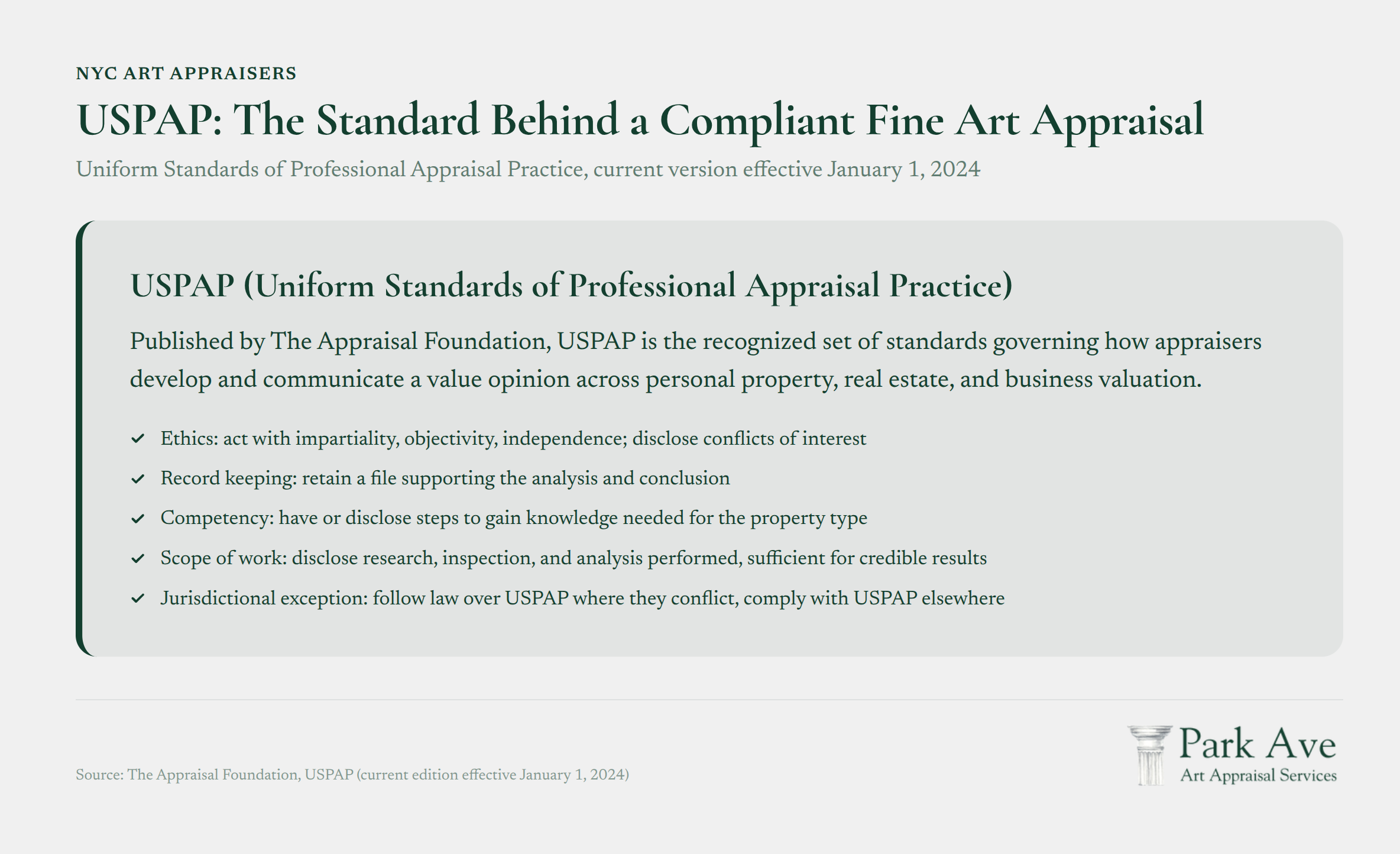
USPAP stands for the Uniform Standards of Professional Appraisal Practice, published by The Appraisal Foundation and updated on a recurring cycle, with the current version taking effect January 1, 2024. It is the recognized set of standards that governs how appraisers across personal property, real estate, and business valuation are supposed to develop and communicate a value opinion.
USPAP isn't a single rule. It's organized around a handful of foundational requirements that apply to every appraisal assignment, regardless of asset type:
- Ethics: the appraiser must act with impartiality, objectivity, and independence, and must disclose any conflict of interest.
- Record keeping: the appraiser must retain a file supporting the analysis and conclusion, available if the report is later questioned.
- Competency: the appraiser must have the knowledge and experience to value the specific type of property, or must disclose the steps taken to acquire that competency.
- Scope of work: the appraiser must disclose exactly what research, inspection, and analysis were performed, and that scope must be sufficient to produce a credible result for the assignment's intended use.
- Jurisdictional exception: if a law or regulation conflicts with a specific USPAP requirement, the appraiser must identify that conflict and comply with the law, while still following USPAP wherever it isn't superseded.
For personal property specifically, including fine art, USPAP separates the analytical work from the reporting work. One standard governs how the appraiser is supposed to develop the value opinion (researching comparable sales, analyzing the relevant market, forming a conclusion). A second governs how that opinion has to be communicated in the final report (identifying the property, stating assumptions, disclosing limiting conditions, and explaining the reasoning clearly enough that someone outside the appraisal profession can follow it). A report that skips either half isn't really USPAP-compliant, even if it cites USPAP on the cover page.
USPAP-Compliant Report vs. Informal Valuation, Verbal Opinion, or Dealer Letter
Here's the short answer: a USPAP-compliant report is a documented, credible, and non-misleading opinion of value with disclosed methodology and stated assumptions. An informal valuation, whether spoken or scribbled on letterhead, is neither.
USPAP applies to oral appraisal communication just as much as written reports; an appraiser who tells a client "it's worth about $40,000" over the phone is bound by the same competency and credibility requirements as one delivering a bound report. What separates a compliant assignment from an informal one is documentation and disclosure, not the format.
An auction house pre-sale estimate is prepared to attract consignments and bidders, not to serve as a defensible valuation for a legal or tax purpose, and it typically doesn't disclose a value premise, an effective date, or the comparable evidence behind the number. A dealer's letter valuing a piece for insurance purposes may reflect real market knowledge, but it usually lacks the independence disclosures, scope of work statement, and signed certification that a USPAP report requires. Neither is inherently dishonest. Both are simply built for a different purpose, and neither is designed to hold up when someone on the other side of a dispute asks how the number was reached.
Watch out: A report that says "prepared in accordance with USPAP" on the cover but omits the value definition, the effective date, or the scope of work section is not actually compliant. The label doesn't substitute for the substance.
Why NYC Attorneys Rely on USPAP-Compliant Appraisals
Attorneys need a valuation that can withstand scrutiny from opposing counsel, a judge, or a taxing authority, and USPAP is the recognized standard that gives a report that credibility. New York doesn't have a standalone statute mandating USPAP for private art valuations, but in nearly every legal context where a work's value is contested, a credible expert report built on a disclosed methodology carries far more weight than an informal opinion.
Common situations where a USPAP-compliant report matters:
- Estate and trust administration: establishing a defensible fair market value as of a decedent's date of death or an alternate valuation date.
- Divorce and equitable distribution: classifying and valuing separately owned or marital artwork in a way both sides, and the court, can evaluate on its merits. Our guide on dividing an art collection in a New York divorce covers how that process typically works.
- Litigation and settlement: providing an expert opinion with stated assumptions, comparable sales, and disclosed limitations that can be challenged or defended on the record.
- Probate and fiduciary accounting: supporting inventories, distributions, and buyouts among beneficiaries.
In each of these contexts, the appraiser's independence and disclosed reasoning matter as much as the final number. A report that hides its methodology invites exactly the kind of challenge an attorney is trying to avoid.
Why Insurers Require USPAP Compliance for Coverage and Claims
Insurers need a value that matches the specific purpose of the policy, and USPAP gives them a report that states that purpose explicitly rather than leaving it implied. A fine art appraisal prepared for insurance should state clearly whether the conclusion is a replacement cost (what it would take to acquire a comparable work through the relevant market), a market value, or another value premise the policy actually calls for. Those numbers are not interchangeable, and a report that doesn't name which one it's using leaves the insurer guessing.
A compliant report gives the insurer a stated effective date, item-level identification with photographs, condition information, the market evidence behind the conclusion, and disclosed assumptions. That documentation matters most after a loss, when a claim for theft, damage, or disappearance has to be adjusted against a number someone can actually stand behind. It also keeps the appraiser's role clean: the appraisal establishes a value opinion, while the policy and the insurer determine what's covered and how the claim is settled.
The IRS, Charitable Donations, and the $20,000 Threshold
For donors, the clearest legal requirement tying art appraisal to USPAP sits in the federal tax code. Any non-cash charitable contribution claimed at more than $5,000 generally requires a qualified appraisal, and the IRS Form 8283 instructions tie the qualified appraisal requirement to the substance and principles of recognized appraisal standards, which USPAP satisfies. The appraiser must also meet the IRS's definition of a qualified appraiser, with verifiable education and experience valuing the specific type of property being donated, as described in IRS Publication 561.
The reporting requirements get stricter as the claimed value rises. For a donated artwork valued at $20,000 or more, the donor must attach a complete copy of the signed appraisal to the tax return along with Form 8283; the form itself is only a summary, not a substitute for the underlying report. The IRS also maintains its own Art Appraisal Services function, which reviews high-value art valuations claimed on returns, another reason a donor's own appraisal needs to hold up to outside review rather than reflect an informal estimate. Timing matters too: the appraisal's effective date generally has to fall within 60 days before the contribution or on the contribution date itself.
Donors weighing a gift to a museum should also understand how these appraisal and reporting requirements interact with the broader charitable deduction rules described in IRS Publication 526, and how the tax benefit is actually calculated, a topic covered in more depth in our guide on donating art to a NYC museum for a tax deduction. General charitable-giving guidance from institutions like Northern Trust echoes the same point: the appraisal has to precede the deduction, not follow it.
Credentials to Look For in a Fine Art Appraiser
USPAP sets the standard for how the appraisal is developed and reported, but it doesn't certify who is qualified to prepare one. That's where professional credentials come in. Our appraisers hold credentials with organizations such as the American Society of Appraisers (ASA), the International Society of Appraisers (ISA), and the Appraisers Association of America (AAA), the organizations most relevant to fine art and personal property valuation. When you're vetting a fine art appraiser for a legal, insurance, or tax matter, ask whether their report will be prepared in accordance with USPAP, what value premise it will use, and whether they hold credentials specific to art and personal property rather than a general business valuation credential.
Key takeaway: The phrase "USPAP-compliant" isn't a marketing label. It describes a specific, disclosed methodology: independence, competency, defined scope of work, and a report an attorney, insurer, or the IRS can actually evaluate rather than take on faith.
If you're navigating an estate, a divorce, an insurance claim, or a planned donation involving fine art, a properly scoped appraisal is the foundation everything else gets built on. Request an art appraisal from our team and we'll walk you through exactly what your situation requires.
This article is provided for general informational purposes only and does not constitute legal, tax, or financial advice. Readers should consult a qualified attorney or CPA regarding their specific circumstances.