
Blog
Dividing an Art Collection in a New York Divorce: How Equitable Distribution Works
An art appraisal in a New York divorce case turns on more than the artwork's price tag: courts first decide whether a piece is marital or separate property, then choose a valuation date under equitable distribution law. This guide walks through that legal framework, the valuation-date debate, and why each spouse typically retains an independent appraiser.
When a marriage ends and the couple owns fine art, the fight is rarely about whether the collection gets divided. It is about how. New York does not split marital assets down the middle by default, and an art appraisal prepared for a divorce case has to answer questions a routine insurance or estate appraisal never has to touch: who owns the piece, when it should be valued, and whether the artist's rising market during the marriage belongs to one spouse or both. Our New York fine art appraisal team prepares USPAP-compliant valuations for exactly these situations, and this guide covers the legal framework behind them.
New York Is an Equitable Distribution State, Not a Community Property State
New York divides marital property equitably, not automatically in half, under Domestic Relations Law Section 236, Part B. That distinction matters enormously for an art collection. In a community property state, each spouse would generally hold a fixed one-half interest in property acquired during the marriage. In New York, a judge instead weighs a list of statutory factors, including the length of the marriage, each spouse's income and separate property, and each party's contribution to acquiring the asset, before deciding what split is fair.
Title alone does not decide ownership either. Under the statute's marital property definition, art acquired by either spouse during the marriage is generally treated as marital property regardless of whose name is on the bill of sale or the gallery invoice, according to general commentary on New York equitable distribution law. A painting one spouse bought with a joint checking account, or even with separate funds but during the marriage, can still be subject to division.
Marital Property vs. Separate Property: What Counts as 'The Collection'
Not every piece in a couple's home is automatically on the table. Property acquired before the marriage, received by inheritance, or given to one spouse individually by a third party is generally treated as separate property and excluded from equitable distribution, unless it has been commingled or transformed in a way that changes its character, as family law commentary on marital versus separate property explains.
This is where an appraisal becomes evidence, not just a number. Establishing the date a piece entered the household, the funding source, and whether it was gifted to one spouse or the couple jointly often decides which side of the marital line an artwork falls on. If you inherited a painting years before the marriage and want to document that it was already yours, our guide on how to find out what a painting is worth covers the research and provenance steps an appraiser walks through before assigning a value.
Example: A husband inherits a mid-century painting from his grandmother two years before marrying. If the painting stayed in his name, was never gifted to the marital estate, and was not commingled with joint funds for restoration or reframing paid from a shared account, it typically remains separate property and is not divided, regardless of how much its value appreciated during the marriage.
When Is the Art Valued? The Commencement-to-Trial Date Debate
New York courts have real discretion over the valuation date for marital property, and for art collections that discretion can swing the number substantially. Under DRL 236(B)(4)(b), a court may set the valuation date anywhere from the commencement of the divorce action to the date of trial, a range that can span several years in a contested matter. Courts often draw a distinction between "active" assets, whose value changes because of one spouse's ongoing effort, and "passive" assets, whose value changes purely with the market, and this distinction has real teeth when applied to art, according to analysis of New York equitable distribution practice.
Art sits in an unusual spot on that spectrum. An artist's market can move sharply between the filing date and the trial date with no action from either spouse, which is precisely what makes courts and commentators describe fine art valuation in New York divorces as an unsettled, fact-specific area of the law. A piece bought for $40,000 five years before the case might appraise for $110,000 by the time the matter reaches trial, and which of those numbers controls can depend on how the court characterizes the asset. We see the same timing tension in other legal contexts. Our guide to art appraisal in Manhattan probate walks through a related version of this problem: picking the correct effective date for an estate appraisal.
Why Both Spouses Usually Hire Their Own Appraiser
Each spouse in a contested divorce typically retains an independent appraiser because a collection's value is rarely a settled fact. Appraisers working in this space generally hold credentials through organizations such as the American Society of Appraisers, the International Society of Appraisers, the Appraisers Association of America, or standards maintained by The Appraisal Foundation, and every credible report is prepared in accordance with the Uniform Standards of Professional Appraisal Practice. A report built to that standard documents the methodology, comparable sales, and reasoning behind the number, which is what a judge needs to weigh competing valuations.
Watch out: A single appraisal commissioned jointly can feel efficient, but if one spouse disputes the outcome later, having no independent second opinion leaves that spouse with little recourse. Most matrimonial attorneys recommend each side commission its own report from the outset.
Courts in New York have also pushed back on shortcuts in how art gets priced for distribution purposes. In Macklowe v. Macklowe, the Appellate Division, First Department affirmed a ruling ordering a contested art collection sold, with the net proceeds split evenly between the parties after the parties could not agree on an in-kind division. That outcome, an ordered sale rather than a forced split of physical pieces, is common when a collection cannot be divided sensibly item by item.
Fair Market Value vs. Value in Use: Why the Standard Matters
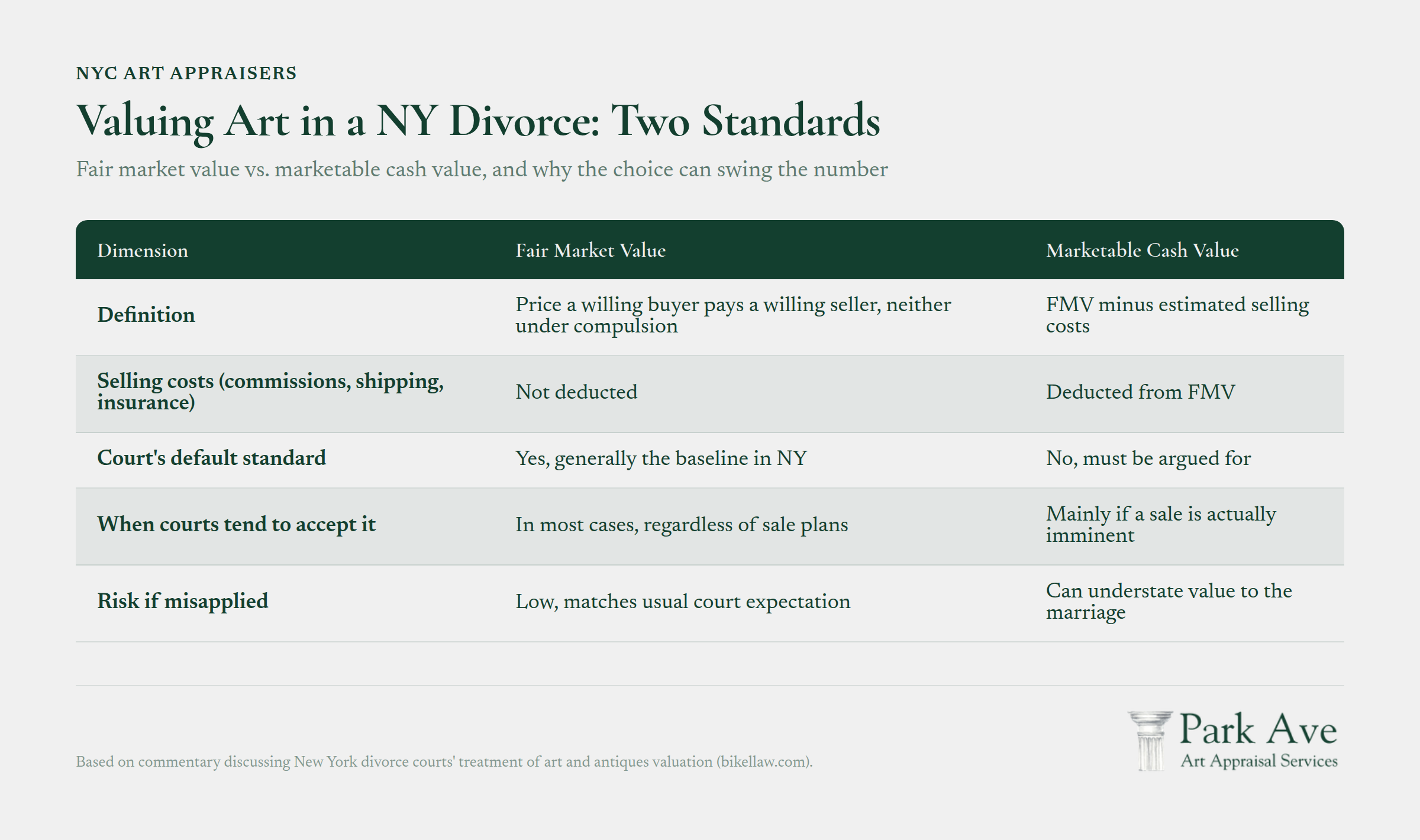
The valuation standard applied to a piece can move the concluded number as much as the valuation date does. New York divorce courts generally use fair market value, the price a willing buyer would pay a willing seller with neither under compulsion, as the baseline standard for dividing art. Litigants and appraisers sometimes argue for marketable cash value instead, which nets out estimated selling costs such as auction house commissions, shipping, and insurance, a distinction that shapes how New York courts approach art and antiques in divorce.
Courts have generally been reluctant to apply that discount automatically. Unless a sale is actually imminent, reducing a painting's value by a hypothetical commission or capital gains tax tends to understate what the asset is genuinely worth to the marriage, which is part of why some judges reject that adjustment outright. The practical lesson: know which standard your appraiser is applying, and make sure it matches what the court in your case actually expects.
A Worked Example: Dividing a $2.4 Million Collection
Example: Consider a Manhattan couple married for 14 years with a collection independently appraised at $2.4 million in aggregate fair market value at the time of trial.
- A $600,000 sculpture the wife inherited from her father 3 years before the marriage, kept titled solely in her name and never commingled with marital funds: classified as separate property and excluded from distribution.
- $1.5 million in contemporary paintings purchased jointly during the marriage from a joint brokerage account: classified as marital property and subject to equitable distribution.
- A $300,000 photography series purchased by the husband during the marriage using an inheritance he kept in a separate account and never mixed with joint funds: this piece requires closer scrutiny, since separate funds used during the marriage can sometimes retain their separate character if properly traced and never commingled.
If the court finds the photography series traceable to separate funds, the marital pool for distribution is the $1.5 million in jointly purchased paintings. A judge weighing the statutory factors, the 14-year marriage length, each spouse's income, and each party's role in building the collection, might order the paintings sold at auction with proceeds split 55/45 in the lower-earning spouse's favor, rather than an even split, precisely because equitable does not mean automatically equal.
Getting a Defensible Number Before Trial
The takeaway for anyone facing this process is straightforward: the appraisal has to be done before the legal argument about ownership and timing can even start. A number without documentation of provenance, acquisition date, and funding source is easy for the other side's attorney to challenge. A number built on a clear valuation date, a defined standard, and a credentialed appraiser's methodology holds up.
Our team prepares independent, USPAP-compliant art appraisals for New York divorce matters, working directly with clients or their attorneys to document ownership history and deliver a report built for litigation. If you need a valuation for a collection currently in dispute, you can request an appraisal and we will scope the engagement to your case's timeline and evidentiary needs.
This article is provided for general informational purposes only and does not constitute legal, tax, or financial advice. Readers should consult a qualified matrimonial attorney regarding their specific circumstances.