
Blog
Donating Art to a NYC Museum for a Tax Deduction: What the IRS Requires
Donating art to a NYC museum can unlock a real tax deduction, but only if a qualified appraisal and IRS Form 8283 are handled correctly. This guide walks through how museums evaluate donation proposals and exactly what dollar thresholds trigger appraisal and disclosure requirements.
New York is one of the few cities in the country where a donor can genuinely choose among world-class institutions for a single painting or a whole collection. That abundance is exactly why so many New Yorkers start researching this topic in the first place: an estate cleanout turns up a family painting, a downsizing move forces a decision about a print collection, or December arrives and a collector wants to close out the tax year with a charitable gift instead of a sale. Whatever the trigger, the same two tracks run in parallel. One is the museum's own acceptance process. The other is the IRS paperwork that makes the deduction stick.
Getting the museum interested is only half the job. The IRS side, particularly the qualified appraisal requirement and Form 8283, is where most donors either lose value or invite an audit they didn't need to invite.
How NYC Museums Actually Evaluate an Art Donation
No major NYC museum accepts art donations by having someone drop off a canvas at the front desk. Every reputable institution routes gift offers through its curatorial and collections management departments, and the process starts with paper, not the physical object.
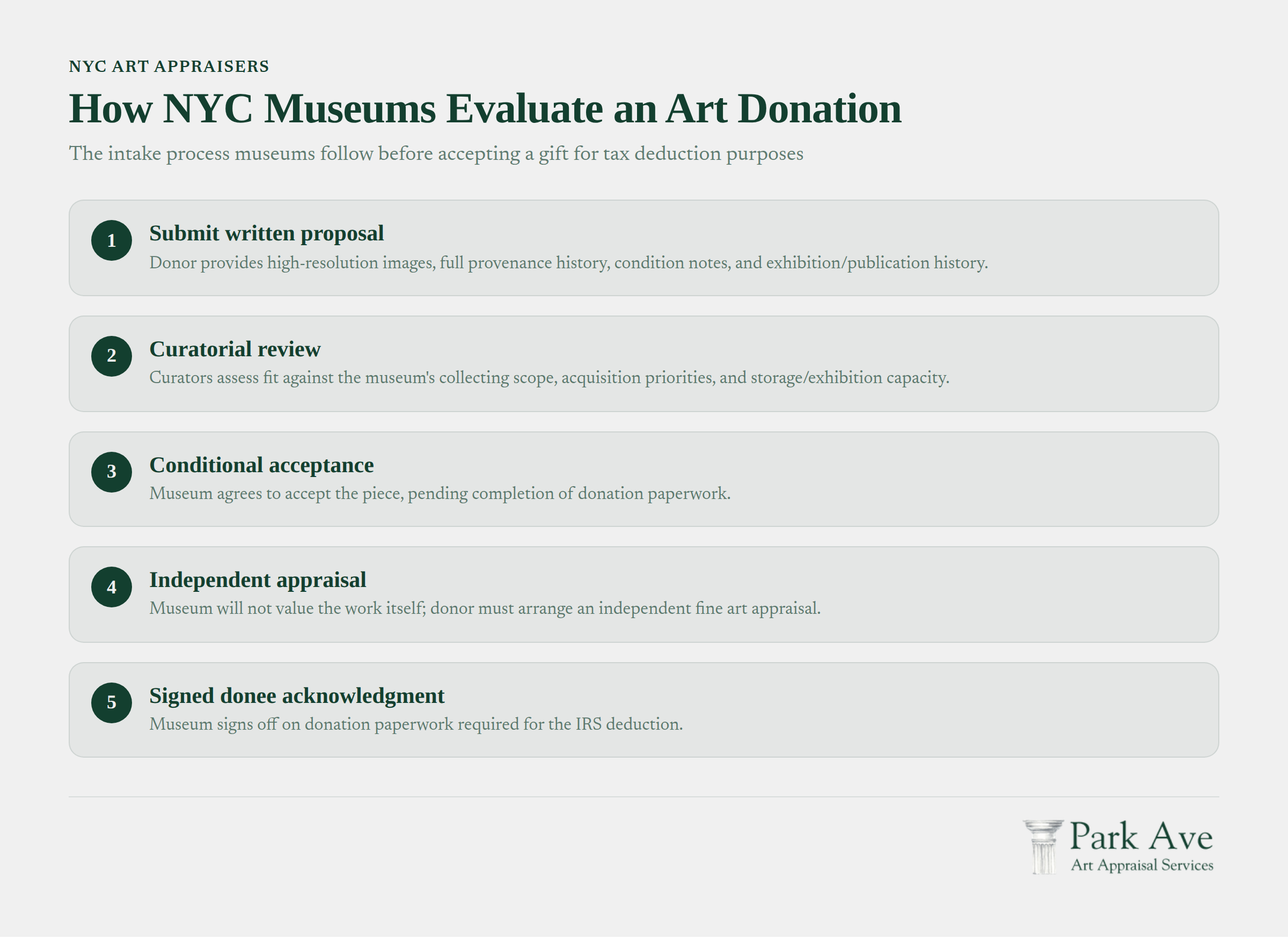
A donor typically submits a written proposal that includes high-resolution images of the work, a full provenance history (who owned it, when, and how it changed hands), condition notes, and any exhibition or publication history. Curators then review the proposal against the museum's existing collection scope, its acquisitions priorities, and its ability to store, insure, and eventually exhibit or study the piece. Many works are declined not because they lack quality but because they simply don't fit where the museum is building its collection.
Here's the detail that surprises first-time donors: the museum will not appraise the work for you. Museums are collecting institutions, not valuation firms, and accepting a value assigned by the very organization receiving the gift would undermine the independence the IRS requires. If the museum agrees to accept the piece, it will ask the donor to arrange an independent fine art appraisal before it will sign off on the donation paperwork.
Where to Propose a Donation in New York City
Each of these institutions maintains its own collecting focus and its own intake process for gift proposals. None of them accept unsolicited physical artwork; all of them start with a written proposal to the relevant curatorial department.
- The Metropolitan Museum of Art: Collects across nearly every culture and era, from ancient antiquities to contemporary art. Gift proposals go to the curatorial department that matches the work's category (European paintings, Asian art, modern and contemporary, and so on), and the Met's acquisitions committees weigh in on anything beyond routine gifts.
- Museum of Modern Art (MoMA): Focused on modern and contemporary painting, sculpture, photography, design, and media art. Proposals typically go through the department matching the medium, and MoMA's curators assess how a piece fits its historical narrative of modernism before recommending acceptance.
- Brooklyn Museum: A broad, encyclopedic collection with particular strength in American art, Egyptian antiquities, and decorative arts. Its collections staff evaluates donation proposals for fit with existing gallery installations and long-term interpretive plans.
- Whitney Museum of American Art: Collects exclusively American art of the 20th and 21st centuries. Works outside that scope, however strong, are usually declined regardless of value, so this is a fit question first and a value question second.
- Museum of the City of New York: Focused specifically on New York City history and culture, including artwork, photography, and ephemera documenting the city itself. This is often a better home for locally significant works that a larger fine-art museum would pass on.
When a piece doesn't fit any of these collecting scopes, university teaching collections are worth considering as an alternate path. Columbia's Wallach Art Gallery and NYU's Grey Art Museum both maintain collections used for scholarship and classroom instruction rather than blockbuster exhibitions, and they sometimes accept works a major museum would decline. Universities that accept gifts of any kind typically publish gift acceptance policies; NYU's policy, for example, spells out that if the university provides the donor anything of value in return for the gift, the donor's deduction is reduced by that benefit's fair market value. That quid pro quo rule applies to museum gifts as well, so any donor receiving membership perks, exhibition credit beyond a standard label, or other consideration in exchange for a donation should factor that into the deduction calculation.
The IRS Thresholds That Control Your Deduction
The museum's acceptance letter gets you in the door. The IRS thresholds determine what documentation you actually need to claim the deduction, and they scale with the value you're claiming, not with which museum you chose.
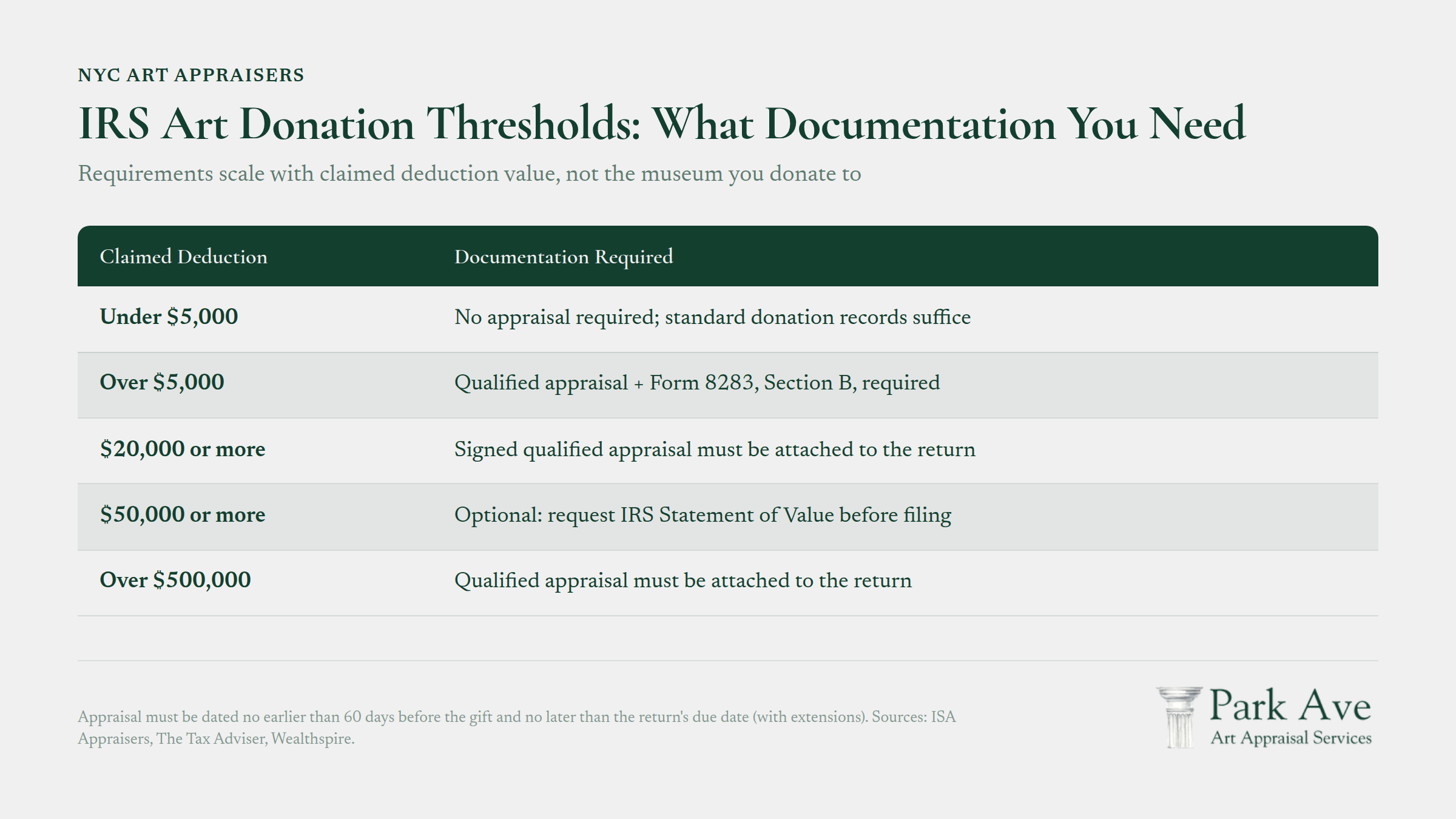
For any donation of art or collectibles where the claimed deduction exceeds $5,000, the IRS requires a qualified appraisal and Form 8283, and the IRS has clarified that this appraisal must be performed by a qualified appraiser following generally accepted appraisal standards. Once the claimed value reaches $20,000, a signed copy of the qualified appraisal must be attached to the tax return itself, not just kept on file. At $50,000 and above, donors have the option to request a Statement of Value from the IRS before filing, which effectively locks in the agency's position on the appraised figure ahead of time. And for any single item or group of similar items exceeding $500,000, the qualified appraisal must be attached to the return regardless of asset type.
| Claimed Deduction | What's Required |
|---|---|
| Under $5,000 | No appraisal required; standard donation records suffice |
| Over $5,000 | Qualified appraisal and Form 8283, Section B, required |
| $20,000 or more | Signed qualified appraisal must be attached to the return |
| $50,000 or more | Optional: request an IRS Statement of Value before filing |
| Over $500,000 | Qualified appraisal must be attached to the return |
Timing matters too. General guidance on appraiser requirements notes that a qualified appraisal must be prepared no earlier than 60 days before the contribution date and no later than the due date of the return, including extensions. An appraisal ordered too early or finalized too late can invalidate the whole deduction even if the value itself is accurate.
Watch out: Donors sometimes assume a receipt from the museum's development office counts as substantiation of value. It doesn't. The receipt confirms the gift happened; only a qualified appraisal establishes the dollar figure the IRS will accept as fair market value.
What a Qualified Appraisal Report Must Establish
A qualified appraisal is a formal report, not a verbal opinion or an auction house estimate emailed as a courtesy. To satisfy IRS requirements, the report generally needs to establish:
- A full description of the artwork, including medium, dimensions, artist attribution, and date of creation
- Physical condition and any restoration history, since damage or repair can materially affect value
- Provenance, tracing prior ownership to the extent it's documented and available
- The valuation method used and the specific comparable sales or market data supporting the concluded value
- The effective date of value, tied to the date of the contribution
- The appraiser's qualifications, including credentials, experience with the relevant category of art, and a statement of independence from the transaction
Our fine art appraisal service in New York prepares reports built around these exact elements, so the documentation is ready before a museum's collections office asks for it. Fees for a fine art appraisal are quoted as a fixed amount after we scope the assignment, based on the number of works, the depth of research required, and whether the report needs to meet the IRS-qualified standard; engagements are never billed hourly.
Form 8283: The Appraiser's Declaration and the Museum's Acknowledgment
Form 8283 has two signature blocks that trip up donors who assume the appraisal alone is enough. Section B of the form requires the appraiser to complete a declaration affirming their qualifications and confirming they understand the penalties for an overstated valuation. That declaration has to be signed before the museum will move forward, because it's the appraiser vouching for the number, not the donor.
The second signature belongs to the receiving institution. The museum's authorized representative signs the donee acknowledgment section confirming it received the described property on a specific date. Museums will not sign this section until the independent qualified appraisal is in hand; it's the mechanism that keeps the museum from ever having to weigh in on value itself. If the museum later sells, exchanges, or otherwise disposes of the donated item within three years, it's generally required to file an additional disclosure with the IRS, which is one more reason curatorial staff take the intake process seriously.
Getting the Paperwork Right Before You Approach a Museum
The sequence that works best in practice runs in this order: confirm the museum's interest with a written proposal, commission an independent qualified appraisal once the museum indicates it will accept the gift, and only then finalize Form 8283 with both the appraiser's declaration and the museum's donee acknowledgment. Trying to reverse that order, especially rushing an appraisal after a verbal yes with no paper trail, is where most avoidable delays and IRS scrutiny originate.
A well-documented appraisal doesn't just satisfy a filing requirement. It gives the donor, the museum, and eventually the IRS the same clear picture of what was given and what it was worth on the date it changed hands.
This article is provided for general informational purposes only and does not constitute legal, tax, or financial advice. Readers should consult a qualified attorney or CPA regarding their specific circumstances.