
Blog
Donate Art to a NYC Museum: Appraisal Requirements at the Met, Brooklyn Museum, MoMA, and Whitney
Donate art to a NYC museum and the appraisal requirements come from the IRS, not the institution. This guide covers what every donor must document, how major NYC museums handle appraisals, and what to confirm before you offer a work.
Donating art to a New York City museum involves two separate processes: the museum decides whether it wants the work, and the IRS decides what paperwork supports your deduction. The appraisal requirements for a donation to a NYC museum come from the second process, and they are the same at every institution. This guide lays out the federal rules first, then walks through how the major NYC museums and other institutions handle appraisals. For the broader tax picture, see our companion guide on donating art to a NYC museum for a tax deduction.
The short answer: NYC museums generally do not appraise donated art for tax purposes. The donor obtains an independent qualified appraisal, and the museum separately decides, through curatorial review, whether to accept the gift.
The IRS Rules That Apply to Every Art Donor, Whatever the Museum
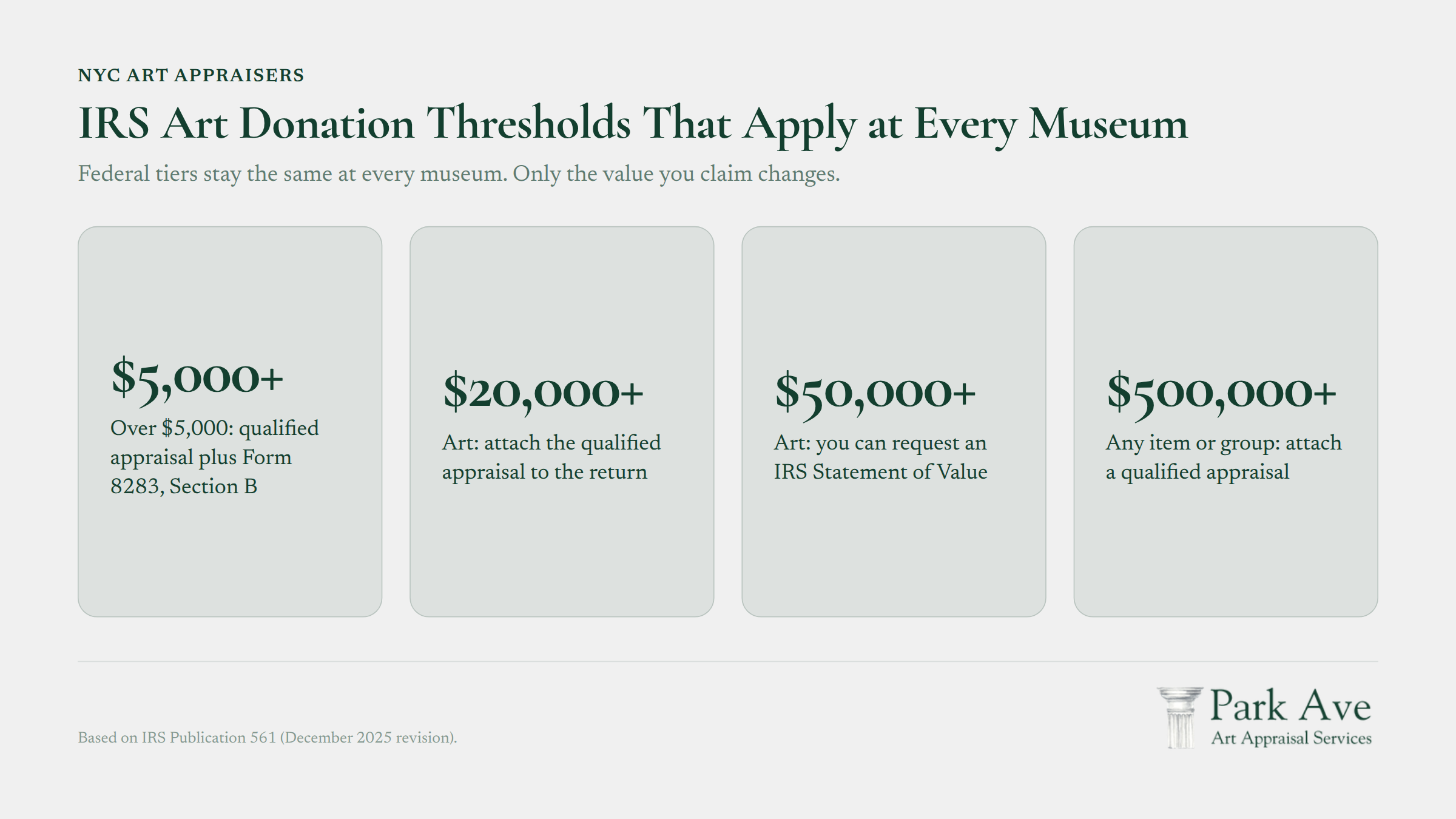
The federal thresholds in IRS Publication 561 (December 2025 revision) do not change from one museum to the next. What changes is the value you claim for the work, or for a group of similar works. Our NYC fine art appraisers prepare reports around these tiers:
- Over $5,000: A deduction above this amount for art requires a qualified appraisal, plus Form 8283, Section B, signed by the appraiser and by the museum as donee.
- $20,000 or more: For art, you attach the qualified appraisal to the return, not just keep it on file.
- $50,000 or more: For art, you can request an IRS Statement of Value. Publication 561 sets out the user fee and the request procedure.
- Over $500,000: For any item or group of similar items, you attach a qualified appraisal to the return.
Three timing and structure rules apply on top of the thresholds:
- Deadline: The qualified appraisal must be in your hands before the due date, including extensions, of the return on which you first claim the deduction. The appraisal is also prepared no earlier than 60 days before the date of the gift.
- One form per donee: If you give to 2 museums, you complete a separate Form 8283 for each.
- Similar items are aggregated: Publication 561 treats similar items (for example, paintings, or lithographs) as one group when you apply the $5,000 and other thresholds. Four prints worth $1,500 each add up to $6,000 and trigger Section B, even though no single print crosses the line.
Example: A donor gives 3 oil paintings to one museum over the course of a tax year, valued at $2,500, $2,800, and $3,100. Each is below $5,000, but the group totals $8,400, so the donor needs a qualified appraisal and a signed Section B.
Do NYC Museums Appraise Donated Art?
No. The institutions we reviewed generally state that they do not appraise donated property for tax purposes, and that the donor must obtain an independent qualified appraisal. That is not a quirk of one museum. It protects the museum's independence, because the institution receiving the gift should not also be the one setting the value you deduct.
Three practical consequences follow:
- The appraisal is the donor's responsibility. You hire the appraiser, you pay for the report, and you make sure it is complete before the return is due.
- A museum can decline a gift. Every institution reviews offers through curatorial review, and may decline or place conditions on a gift, even when you hold a strong appraisal.
- An appraisal is not an acceptance document. Curators weigh collection fit, condition, provenance, and legal title. Your appraiser addresses fair market value for tax substantiation. Neither answers the other's question.
NYC Museum Art Donation Requirements at a Glance
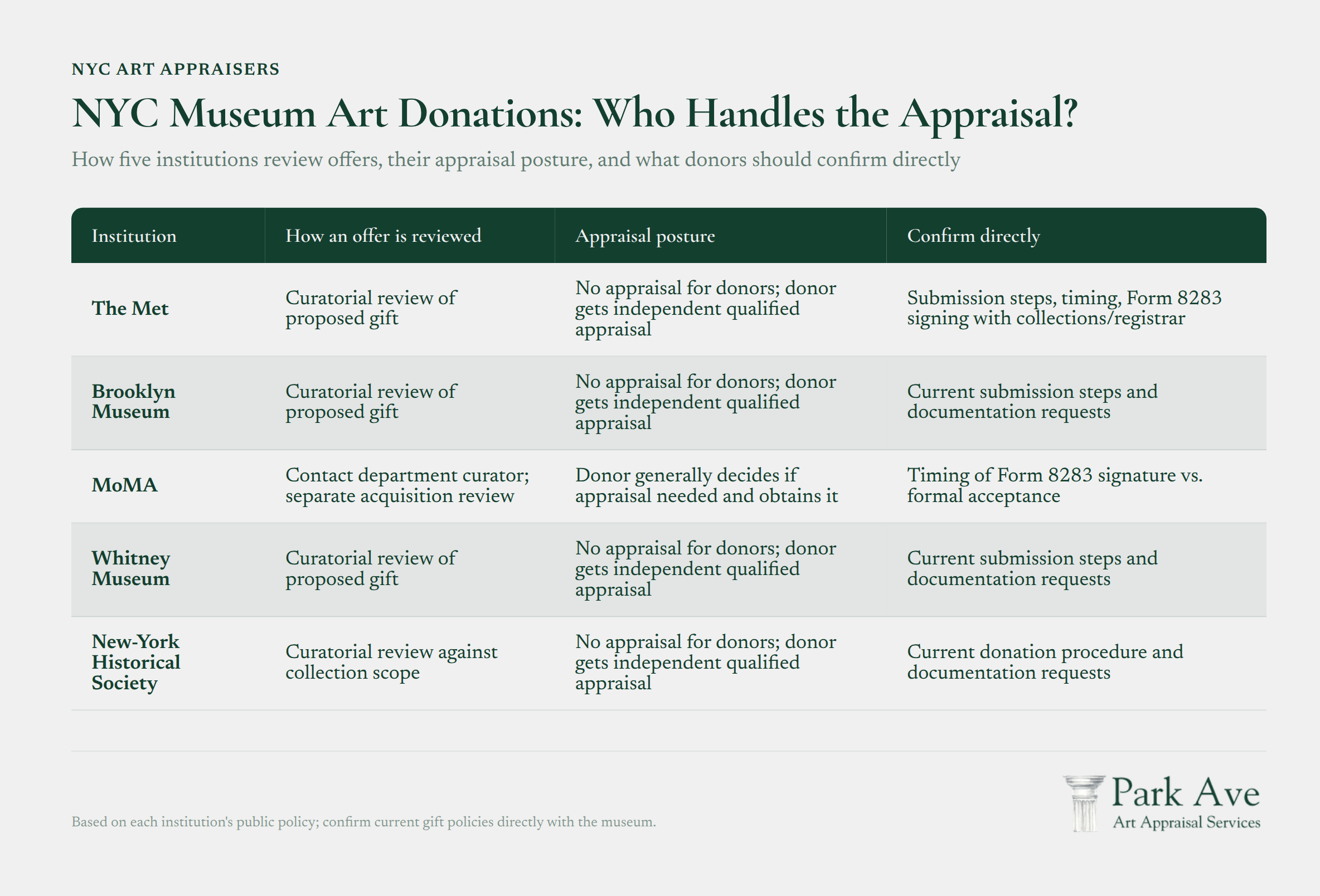
The table below summarizes what each institution's public policy tells donors about appraisals. Where we have not verified a museum's current gift policy, the table says to confirm with the institution rather than guess.
| Institution | How an offer is reviewed | Appraisal posture | What to confirm directly |
|---|---|---|---|
| The Metropolitan Museum of Art | Curatorial review of the proposed gift | Does not appraise for donors; donor obtains an independent qualified appraisal | Current submission steps, timing, and Form 8283 signing process with the collections or registrar office |
| Brooklyn Museum | Curatorial review of the proposed gift | Does not appraise for donors; donor obtains an independent qualified appraisal | Current submission steps and documentation requests |
| Museum of Modern Art (MoMA) | Contact the curator in the relevant department; separate acquisition review | Donor generally decides whether an appraisal is needed and is responsible for obtaining it | Timing of Form 8283 signature relative to formal acceptance |
| Whitney Museum of American Art | Curatorial review of the proposed gift | Does not appraise for donors; donor obtains an independent qualified appraisal | Current submission steps and documentation requests |
| New-York Historical Society | Curatorial review against collection scope | Does not appraise for donors; donor obtains an independent qualified appraisal | Current donation procedure and documentation requests |
Institution-by-Institution Notes
The Metropolitan Museum of Art
The Met reviews offers through curatorial review, may decline or condition a gift, and does not appraise donated art for tax purposes. Donors should secure their own qualified appraisal and ask the collections or registrar office how and when the museum will sign Form 8283.
Brooklyn Museum
The Brooklyn Museum follows the same pattern: curatorial review first, no appraisal service for donors, and the freedom to decline. Confirm current submission steps and any documentation it wants (images, provenance, condition) with the collections or registrar office before sending anything.
Museum of Modern Art
MoMA's published gift-acceptance policy directs prospective donors to contact the curator in the relevant curatorial department. According to MoMA's gift acceptance policy, the donor generally determines whether an appraisal is necessary and is responsible for obtaining it, along with independent legal, tax, and financial advice. A gift is also reviewed separately through the museum's acquisition process, so a finished appraisal does not commit the museum to accept the work.
Whitney Museum of American Art
The Whitney reviews proposed gifts through its curatorial staff and does not appraise donated art for donors. Because its focus is American art, the work's fit with the collection is a threshold question that no appraisal can answer. Confirm current submission requirements directly.
New-York Historical Society
The New-York Historical Society collects against a defined scope of history and art, so relevance to that scope drives the decision. Like the others, it does not provide a tax appraisal. Ask the collections office for its current donation procedure and what it needs from you before review.
University Galleries and Smaller Historical Societies
University galleries and smaller historical societies in the city tend to have narrower collecting missions and smaller staffs than the large museums. We do not publish institution-specific policies for these organizations because we have not verified them, and you should not assume they mirror the larger museums.
Before you offer a work to one of them, ask the collections contact these questions:
- Is there a written gift policy? Many institutions publish one; ask for it.
- Who signs Form 8283, Section B, and when? Some organizations will not sign until formal acceptance.
- Will the work be used for the institution's exempt purpose? This matters for the related-use rule discussed below.
- Are there conditions or restrictions? A condition on display, resale, or deaccessioning can affect both acceptance and the tax analysis.
Other NYC Institutions With Published Policies
Several other New York institutions state their positions publicly, and they reinforce the same pattern:
- Museum of the City of New York: Its collections policies state a longstanding policy of not providing appraisals to donors. A curator may suggest qualified appraisers, but the museum does not arrange or pay for the appraisal.
- The Bronx Museum of the Arts: Its donation policies say it does not provide appraisal, authentication, or identification services. It also recommends that donors photograph, copy, or appraise works before sending them.
- Museum of Jewish Heritage: Its donation guidance says it cannot provide appraisals, and that after acceptance it may make an object available to the donor's chosen appraiser with sufficient notice.
What the Museum's Signature on Form 8283 Does and Does Not Mean
The museum signs Section B as the donee, acknowledging that it received the property. That signature is not an appraisal, an endorsement of your claimed value, or a promise that the IRS will allow the deduction. The museum validates receipt, not value.
A museum may also decline to sign until the work has been formally accepted, or until the transfer terms are clear. Ask about timing early, because the signed form and the qualified appraisal both need to be in order before your return is filed.
The related-use rule is a separate question again. For tangible personal property such as art, Publication 561 explains that if the museum puts the gift to a use unrelated to its exempt purpose, the deduction can be limited, generally to your cost basis rather than fair market value. Whether the museum's use is related depends on what it actually does with the work, and neither your appraisal nor the museum's acceptance letter settles that on its own.
Watch out: Do not treat acceptance as proof of full fair market value deductibility. Acceptance, related use, and appraisal are 3 separate issues, and each should be checked on its own.
Getting the Qualified Appraisal Right
A qualified appraisal must be prepared by a qualified appraiser in accordance with USPAP, the Uniform Standards of Professional Appraisal Practice published by The Appraisal Foundation. It must describe the work in enough detail to identify it, state the valuation date and the fair market value, explain the method and the specific basis for the value, and include the appraiser's qualifications and required declarations. Our guide to what makes a fine art appraisal USPAP-compliant goes deeper on those elements.
No museum requires a particular appraiser. What matters is that the appraiser meets the IRS definition, is independent of you and the museum, and has experience valuing the type of art you are donating. Our appraisers hold credentials with leading organizations such as the ISA, ASA, and AAA, and our reports are prepared in accordance with USPAP and IRS requirements.
On cost, our fees are fixed and quoted before work begins, never hourly. For artwork, IRS-qualified appraisals start from $395. The final fee depends on scope: the number of works, the complexity of attribution and provenance, and the completeness of your records.
Before You Offer a Work to a Museum
The order of operations protects both the donation and the deduction. Work through these steps:
- Contact the collections or registrar office first.
- Ask for the written gift policy and the current submission process.
- Offer the work for curatorial review.
- Provide images, artist and medium details, dimensions, condition, and provenance as requested.
- Commission your qualified appraisal.
- Time it to fall within 60 days before the gift and before your return is due, including extensions.
- Complete Form 8283, Section B.
- Use one form per museum, and ask when the museum will sign.
- Attach the appraisal when required.
- That means art with a claimed value of $20,000 or more, and any item or group over $500,000.
If your claimed value reaches $50,000, consider whether to request a Statement of Value before filing. Whatever the amount, confirm every institution-specific step with the museum itself. Policies change, and the museum's current staff are the only reliable source.
This article is provided for general informational purposes only and does not constitute legal, tax, or financial advice. Readers should consult a qualified attorney or CPA regarding their specific circumstances.