
Blog
New York Estate Tax on Art Collections: Thresholds, the Cliff, and How NYC Executors Report Value
New York's estate tax exemption is far lower than the federal exemption, and a valuable art collection is often exactly what pushes a Manhattan estate over the line. This guide walks NYC executors through the thresholds, the cliff, and what a qualified appraisal must show on Form 706 and Form ET-706.
An estate can owe zero federal estate tax and still owe a substantial New York estate tax bill. That gap catches a lot of Manhattan executors off guard, and a valuable art collection is frequently the asset that tips an estate from "no tax owed" into six-figure New York liability. This guide covers the New York thresholds, the state's unusual "cliff" rule, and how we help executors and their attorneys report an art collection's value on both the federal and New York estate tax returns.
Why New York's Estate Tax Catches Art-Rich Estates Off Guard
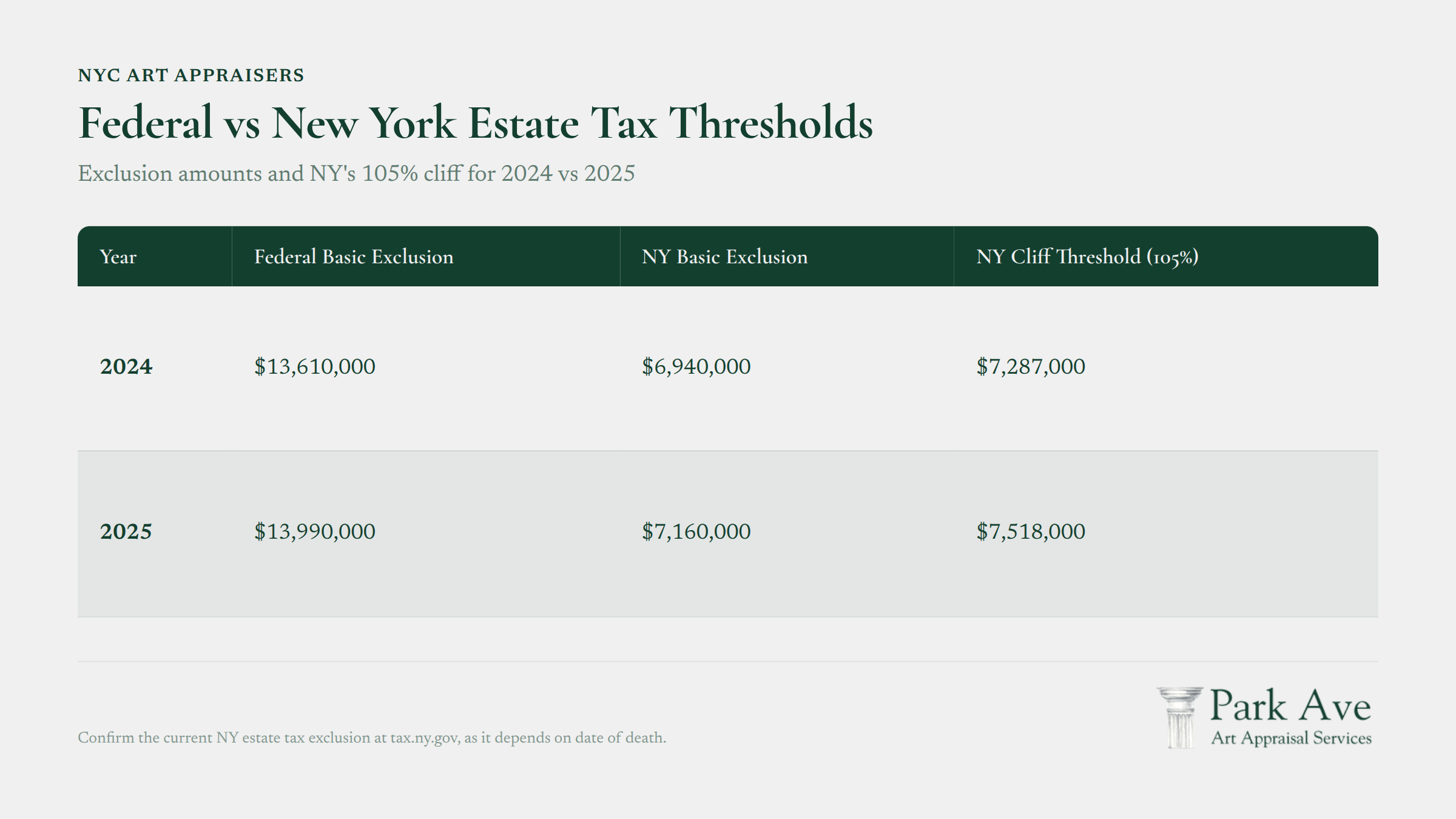
New York imposes its own, separate estate tax under New York Tax Law Section 952, independent of the federal estate tax and with a much lower exemption. For deaths in 2024, the federal basic exclusion amount was $13.61 million, rising to $13.99 million for deaths in 2025. New York's basic exclusion amount for the same years was $6,940,000 and $7,160,000, respectively.
That means an estate worth $8 million in 2025 owes nothing to the federal government but could owe New York estate tax on more than $800,000 of value. For a New York resident decedent, the New York gross estate generally starts from the federal gross estate and applies New York's own modifications under Tax Law Section 954, which is why the art collection reported on the federal return carries straight through to the state filing.
A collection that has been insured for decades at a round, unexamined number, or that was never formally appraised at all, is often the single line item that decides whether an estate crosses the New York threshold. We prepare our estate appraisal services for art collections with that threshold math in mind from the first conversation, not as an afterthought once the return is already due.
New York's Estate Tax Cliff: How a Borderline Appraisal Can Swing an Estate
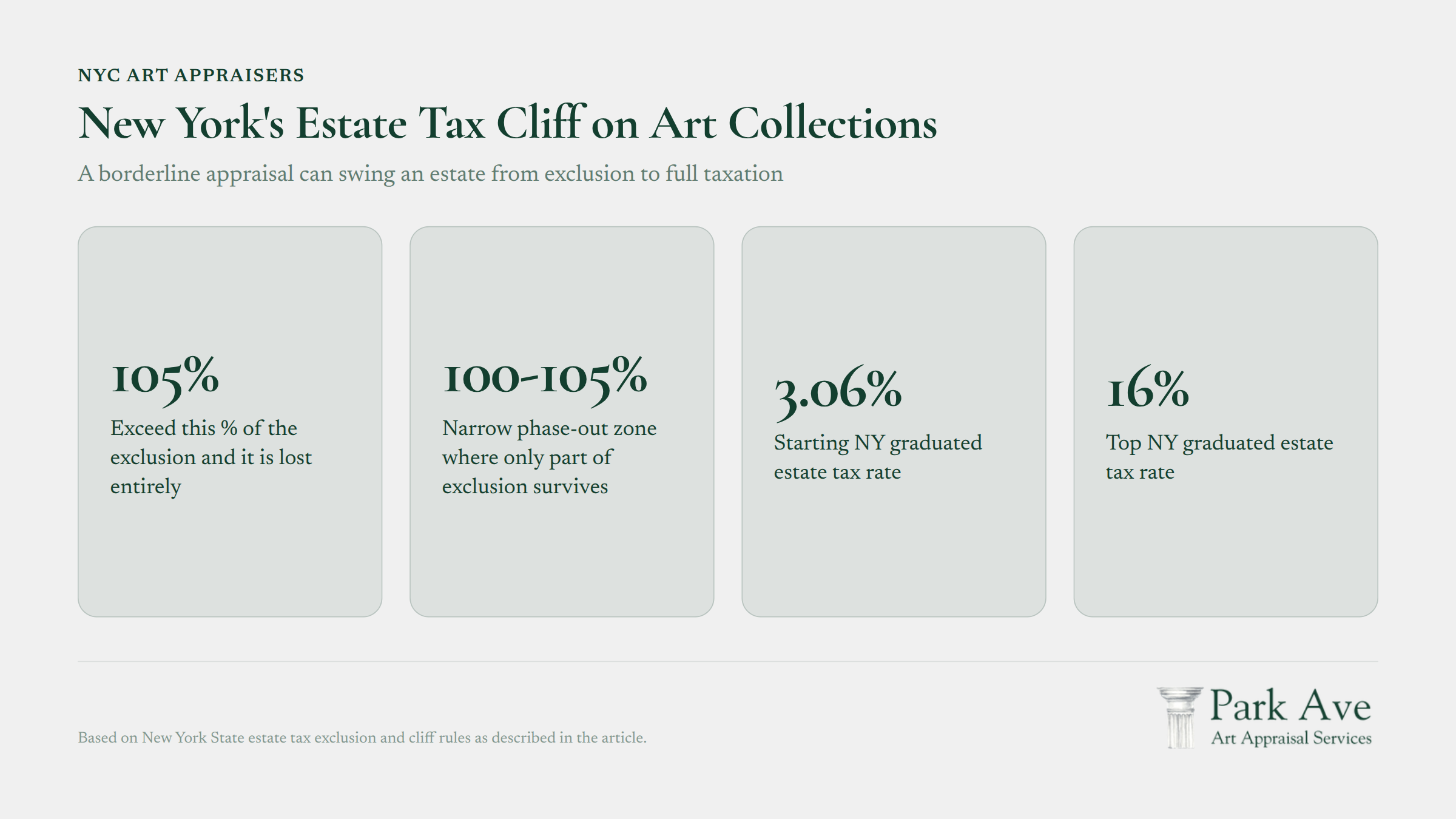
New York's exclusion does not phase out gradually. If the New York taxable estate exceeds the exclusion amount by more than 5% (in other words, exceeds 105% of the exclusion), the estate loses the exclusion entirely, and New York estate tax is calculated on the full value of the estate, not just the amount over the threshold. Estates valued between 100% and 105% of the exclusion sit in a narrow phase-out zone where only part of the exclusion survives.
This is what makes a defensible, item-by-item appraisal of an art collection so important. A collection valued at $200,000 above a rough estimate can be the difference between an estate sitting comfortably under the exclusion and an estate falling off the cliff into tax on its entire value, not just the excess. New York's estate tax rates are graduated, starting at 3.06% and reaching a top rate of 16%, so the stakes of a borderline valuation compound quickly once the cliff is triggered.
Key takeaway: on a New York estate near the exclusion amount, the appraised value of the art collection is not just a reporting detail. It can determine whether the exclusion applies at all.
Federal vs New York Estate Tax Thresholds for 2024 and 2025
The federal and New York exclusion amounts move independently, and the gap between them has only widened in recent years. The table below lays out the figures executors are working with for estates in 2024 and 2025.
| Year | Federal basic exclusion | New York basic exclusion | New York cliff threshold (105%) |
|---|---|---|---|
| 2024 | $13,610,000 | $6,940,000 | $7,287,000 |
| 2025 | $13,990,000 | $7,160,000 | $7,518,000 |
New York updates its exclusion amount periodically, and the figure applicable to a given estate depends on the decedent's date of death, so executors should confirm the current New York estate tax exclusion amount before relying on a prior year's number. A federal exclusion nearly double New York's means a great many Manhattan estates that clear the federal bar with room to spare still need a New York estate tax return, and still need a defensible appraisal to support it.
How NYC Executors Report an Art Collection on Form 706 and Form ET-706
A New York resident estate that owes New York estate tax files Form ET-706, generally built on the schedules already prepared for the federal Form 706. A separate nonresident return, Form ET-90, applies when a nonresident decedent owned New York-situs property, which can include artwork that is physically located in a Manhattan apartment, gallery, or storage facility even if the owner lived elsewhere.
For the art collection itself, the practical reporting sequence looks like this:
- List each work separately, or attach a detailed schedule identifying artist, title, medium, dimensions, and date for every piece.
- Report the collection as tangible personal property on the applicable federal Form 706 schedule, generally Schedule F, using the fair market value as of the date of death.
- Attach the appraisal supporting each value, along with an explanation of any discounts, fractional interests, or restrictions.
- Carry the federal figures into Form ET-706, applying New York's own modifications under Tax Law Section 954.
- Identify any art located outside New York, since the ET-706 instructions require a separate list of real and tangible personal property held outside the state but included in the federal gross estate.
Executors can also elect alternate valuation, which generally values the estate's property six months after death (or at the date of disposition, if earlier) instead of the date of death. The election must apply to the whole estate, not selectively to works whose value happened to drop, and it is made by checking the corresponding box on the federal return filed with New York. For a collection with works that moved significantly in the market during that six-month window, the choice between the two valuation dates can matter as much as the appraisal itself.
One qualified appraisal, prepared to a high evidentiary standard and dated as of the decedent's date of death, generally supports both filings, since both the federal and New York returns start from the same fair market value definition.
What a Qualified Appraisal Must Show for Estate Purposes
Art and collectibles valued at roughly $3,000 per item, or $10,000 for a collection of similar items, generally require a sworn appraisal from a qualified expert for estate purposes. Once an individual work is valued at $20,000 or more, the complete signed appraisal typically needs to be attached to the federal return, and the IRS can refer appraisals of major works to its Art Advisory Panel for review. For art valued at $50,000 or more, an executor can request an IRS Statement of Value before filing, locking in the agency's position on that piece ahead of time.
A defensible appraisal for a Manhattan estate's art collection should document:
- Attribution and physical description: artist, title, medium, dimensions, date, and edition or series information where relevant.
- Provenance and ownership history: a chain of custody that supports authenticity and marketability.
- Condition and authenticity: including any restoration, conservation records, or authentication disputes.
- Comparable sales: auction results and private-sale data that are genuinely comparable in artist, period, and quality, not just same-category filler.
- Exhibition and publication history: factors that can meaningfully move value for recognized artists.
- Location: whether each work sits in New York or elsewhere, since this affects the ET-706 out-of-state property schedule.
"Fair market value is the price at which the property would change hands between a willing buyer and a willing seller, neither being under any compulsion to buy or to sell and both having reasonable knowledge of relevant facts."
Courts reviewing contested estate appraisals have consistently favored appraisers with direct, demonstrable expertise in the specific category of art being valued, and have penalized reports built on vague comparables or prepared by generalists without a documented specialty. This is general industry knowledge worth taking seriously: a well-credentialed appraiser in the wrong specialty can be just as vulnerable to challenge as an uncredentialed one. Our appraisers hold credentials with organizations such as the ASA, ISA, and AAA, and every estate report we prepare is built to a USPAP-compliant standard so it holds up under scrutiny from the IRS, the New York Department of Taxation and Finance, or opposing counsel in a contested estate.
For a collection with pieces spanning several categories, such as paintings, photographs, and decorative arts, separate specialist analysis within the same report is often appropriate. A dealer's informal opinion, an auction house estimate, or an old insurance schedule is not the same thing as a qualified appraisal prepared for estate tax purposes, and relying on one can leave an estate exposed exactly at the threshold or cliff calculation that matters most.
Getting the Appraisal Right Before the Return Is Due
New York's estate tax return is generally due nine months after the date of death, with a possible six-month extension to file (though not necessarily to pay). That timeline moves fast once probate administration, asset inventories, and family logistics are added on top of it, and an art collection is rarely the easiest asset to value under pressure.
Our estate appraisal engagements for art collections are quoted as a fixed fee after we review the scope of the collection, the number of works, and whether the intended use calls for an IRS-qualified report. If your estate includes artwork and you need a date-of-death valuation that will support both the federal Form 706 and New York's Form ET-706, request an appraisal and our team will walk you through what the engagement involves before any work begins.
This article is provided for general informational purposes only and does not constitute legal, tax, or financial advice. Readers should consult a qualified attorney or CPA regarding their specific circumstances.