
Blog
How Art Appraisal Works in New York Probate for a Manhattan Estate
When a Manhattan estate includes fine art, the executor must establish a defensible fair market value as of the date of death, and federal rules require a qualified appraiser's sworn opinion for any item or collection worth more than $3,000. This guide walks fiduciaries and estate attorneys through the inventory duty, the Form 706 and ET-706 appraisal requirements, and what a report needs to survive Surrogate's Court scrutiny.
Fine art creates a specific kind of headache for the executor of a Manhattan estate. Cash has an obvious value. A brokerage account has a statement. A painting, a set of etchings, or a cabinet of decorative objects has none of that, and New York probate law does not let the executor guess. This article walks through what the Surrogate's Court framework, the federal Form 706 rules, and New York's Form ET-706 actually require when fine art sits inside an estate, and what a fiduciary needs from an appraiser to defend that value later.
The Executor's Duty to Inventory Estate Property
An executor appointed in a New York Surrogate's Court proceeding has a fiduciary obligation to identify, collect, and account for every asset of the estate, and that duty applies to tangible personal property exactly as it applies to bank accounts and real estate. The Surrogate's Court process is built around the idea that an estate's assets are matters of public record once a petition is filed, which means the inventory an executor prepares can be reviewed by beneficiaries, creditors, and the court itself.
For a Manhattan estate that includes fine art, this duty means more than jotting down "paintings, various" on a schedule. Courts and estate attorneys who regularly handle New York probate matters describe a room-by-room, item-level approach to cataloguing antiques and artwork, because a vague description invites challenge from beneficiaries who suspect an item was undervalued, or from the Department of Taxation and Finance if the estate owes New York estate tax. We are not citing a specific section number of the Surrogate's Court Procedure Act here because the exact statutory citation should be confirmed with estate counsel for the particular proceeding, but the general obligation, to inventory and account for all estate property before distribution, is a foundational part of every New York probate administration.
Pro tip: Photograph and catalogue art collections as early in the estate administration as possible. Provenance documents, prior insurance schedules, and gallery receipts are far easier to locate in the first weeks after death than a year into the proceeding.
Fair Market Value: The Standard for Art in a New York Estate
New York does not use a special formula for valuing art in probate. Art is valued at its fair market value as of the decedent's date of death, the same standard used on the federal estate tax return and carried directly onto New York's Form ET-706.
Fair market value, as defined under federal estate tax regulation, is what a willing buyer would pay a willing seller when neither is under compulsion to act and both have reasonable knowledge of the relevant facts, a standard set out in 26 CFR 20.2031-6. That is a market-based test, not an insurance replacement value, a retail asking price, or an auction house's pre-sale estimate. It also is not what the decedent paid for the piece decades earlier. An estate attorney or executor who defaults to an old insurance appraisal or a gallery invoice risks reporting a value that has no relationship to what the item would actually bring on the open market on the date it matters.
If the estate makes a federal alternate valuation election, the relevant valuation date can shift to six months after death for qualifying assets, which can matter for a Manhattan collection if the art market moved meaningfully in that window. For the current year, New York's basic exclusion amount is $7,350,000 for dates of death from January 1, 2026 through December 31, 2026, and the ET-706 return is generally due within nine months of death, the same nine-month window as the federal filing.
The $3,000 Threshold: When a Qualified Appraisal Is Required
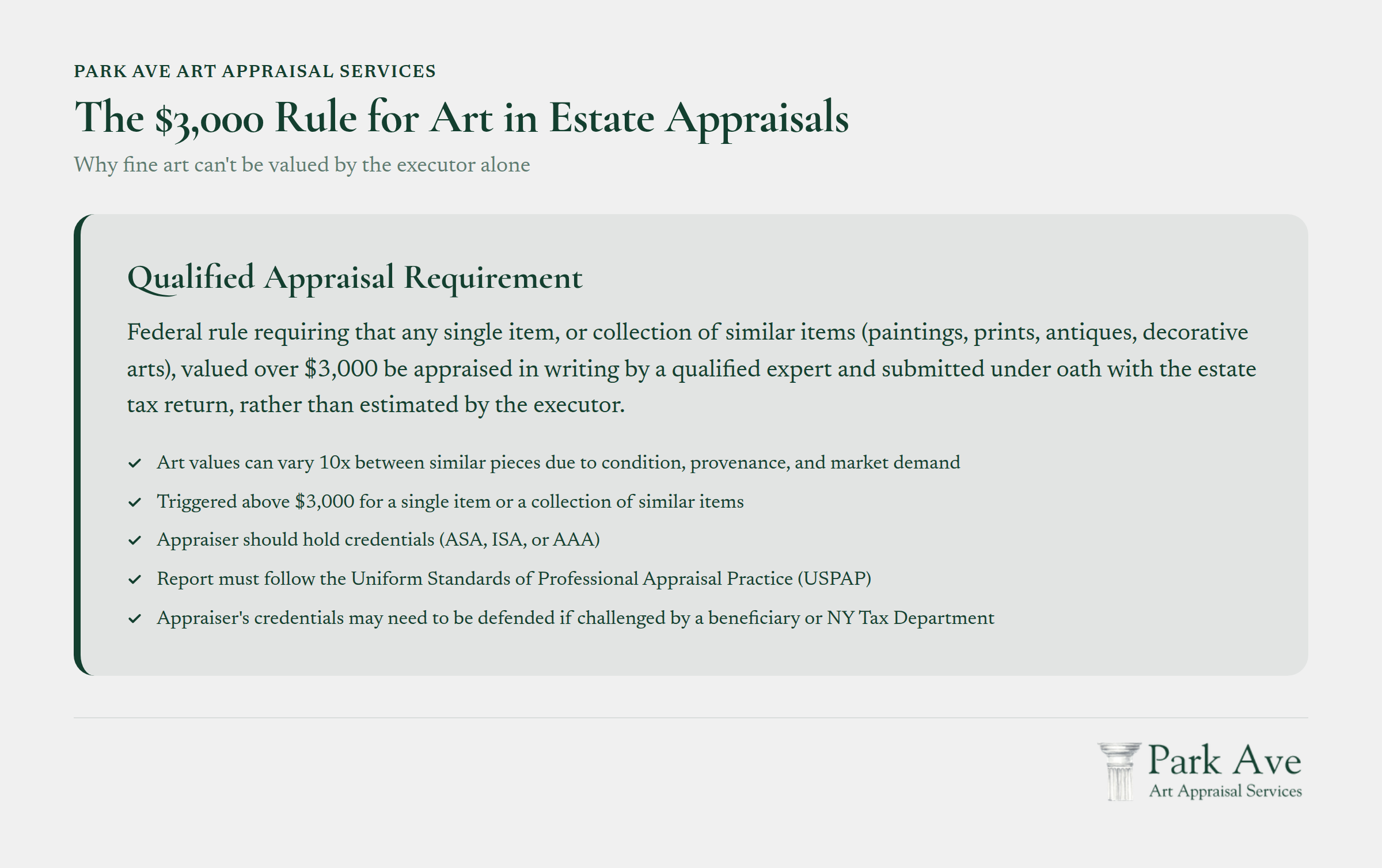
Federal estate tax rules require a written appraisal by a qualified expert, submitted under oath with the return, for any single item or collection of similar items of household and personal effects valued at more than $3,000. That threshold, set under 26 CFR 20.2031-6, specifically calls out paintings, etchings, engravings, antiques, statuary, vases, oriental rugs, coins, and stamps as the kind of property that triggers the requirement.
In practice, this threshold is low enough that almost any Manhattan estate with real art holdings will cross it. A single mid-career painting, a set of signed prints, or even a grouping of decorative bronzes can each individually exceed $3,000 in value, which means each becomes a candidate for a formal appraisal rather than a line-item estimate by the executor or a family member.
Watch out: "Collection of similar items" is an aggregation rule. Five prints by the same artist, each worth $1,000, are treated as a $5,000 collection for this purpose, not five separate items under the threshold.
Why Fine Art Needs a Qualified Appraiser's Opinion
Cash, publicly traded securities, and even most real estate have an observable market price on any given day. Fine art does not. Two paintings by the same artist, similar in size and subject, can carry values that differ by a factor of ten depending on condition, provenance, exhibition history, and which collectors are active in that artist's market at that moment. That is precisely why the federal rule singles out art and other collectibles for expert appraisal rather than allowing the executor's own estimate.
A qualified appraiser working on a Manhattan estate typically holds credentials from an organization such as the American Society of Appraisers (ASA), the International Society of Appraisers (ISA), or the Appraisers Association of America (AAA), and prepares the report in accordance with the Uniform Standards of Professional Appraisal Practice. That credentialing matters because the appraiser's qualifications, not just the number in the report, are what an executor may need to defend if a beneficiary or the Department of Taxation and Finance challenges the value. Our fine art appraisal service works with fiduciaries and estate attorneys across Manhattan on exactly this kind of assignment, from a single significant painting to an entire apartment's worth of decorative arts.
What the Appraisal Report Needs to Withstand Surrogate's Court Scrutiny
A report that will hold up in a contested accounting or an audit needs more than a final number. At minimum, a defensible estate appraisal for art should include:
- A detailed description of each item: artist or maker, medium, dimensions, date of creation, edition or signature information, and condition.
- The specific date of death (or alternate valuation date) used as the effective date of value.
- The methodology applied, typically the sales comparison approach using recent, comparable auction and private sale results for similar work.
- The appraiser's qualifications, including relevant credentials and experience with the artist, period, or category involved.
- A signed certification, since the federal rule requires the appraisal be submitted under oath.
A report missing any of these elements is an easy target in a will contest or a challenge from a residuary beneficiary who believes the art was undervalued to reduce the estate's apparent worth (or, less often, overvalued to inflate a charitable deduction elsewhere in the estate plan). Executors who commission an appraisal that only states a dollar figure, without the supporting analysis, are exposing the estate to exactly the kind of dispute the appraisal was supposed to prevent.
Worked Example: A Manhattan Collection at Date of Death
Consider an estate administered through New York County Surrogate's Court where the decedent's Upper East Side apartment held three categories of art and decorative property.
| Item | Description | Appraised Fair Market Value (Date of Death) |
|---|---|---|
| Painting | Mid-20th-century oil on canvas, signed, gallery provenance | $85,000 |
| Prints (set of 6) | Signed limited-edition lithographs by the same artist | $18,000 |
| Decorative arts | Bronze sculptures, porcelain, and a pair of Chinese vases | $12,500 |
Each category exceeds the $3,000 threshold on its own, so each required a written appraisal under oath filed with the federal return. The painting alone required the most detailed comparable-sales analysis, since a single work at that value carries the greatest exposure if challenged. The six prints were treated as a collection of similar items rather than six individual pieces under the threshold, consistent with the aggregation rule. The decorative arts grouping needed a specialist familiar with Chinese porcelain and mid-century bronze markets, since a generalist appraisal in that category is more likely to be questioned during an accounting.
Example: If this estate's total gross value, including the $115,500 in art and decorative property plus other assets, exceeds the current New York basic exclusion amount, the executor must file Form ET-706 and attach copies of the qualified appraisals used on the federal return, since New York's estate tax instructions require the same supporting appraisals filed with the federal return to accompany the state filing.
Filing the Appraisal Alongside Form ET-706
New York does not ask for a separate, state-specific art appraisal. Instead, the ET-706 instructions direct the executor to attach the same qualified appraisals prepared for federal Form 706, along with the federal return itself, to the New York filing. This is one reason it makes sense to commission the appraisal once, to a standard that satisfies both the IRS's under-oath requirement and any scrutiny the New York State Department of Taxation and Finance might apply during a review or audit.
Given that a single report often needs to serve the federal return, the state return, and a potential Surrogate's Court accounting all at once, the fee for that report is quoted as a fixed cost after the appraiser scopes the assignment, based on the number of items, the depth of research each piece requires, and whether the report needs to meet the IRS-qualified standard. Readers weighing that decision for a smaller estate can review our breakdown of what an artwork appraisal typically costs for more detail on how scope affects the fee. Fixed-fee, quoted before work begins, is standard practice; appraisal engagements are never billed by the hour.
Getting the Estate's Art Appraisal Right the First Time
An executor administering a Manhattan estate with meaningful art holdings is balancing two competing risks: reporting a value too low and inviting an audit or a beneficiary dispute, or reporting a value too high and overstating the estate's tax liability. The way to manage both is the same, a qualified appraiser's date-of-death fair market value opinion, documented to the standard the federal rule and New York's ET-706 instructions expect. That documentation protects the executor personally, since a fiduciary who relies on a properly qualified appraisal has a defensible record if the valuation is ever questioned.
If you are an executor or estate attorney preparing an inventory or accounting for a Manhattan estate that includes fine art, request an appraisal to get a scoped, fixed-fee quote for a USPAP-compliant report suitable for Form 706, Form ET-706, and Surrogate's Court proceedings.
This article is provided for general informational purposes only and does not constitute legal, tax, or financial advice. Readers should consult a qualified attorney or CPA regarding their specific circumstances.