
Blog
Selling Inherited Art From a New York Estate: Capital Gains and Step-Up Basis Rules
Capital gains tax on inherited art in New York is calculated from a stepped-up basis set at the date of death, not the decedent's original purchase price. This guide walks through the step-up rule, the 28% collectibles rate, and the appraisal documentation a Manhattan heir needs before consigning a piece for sale.
When a New York estate includes artwork, the heir's biggest tax question usually has nothing to do with the painting's history and everything to do with what happens the day it sells. Capital gains tax on inherited art in New York starts with a rule that surprises a lot of people: the number used to calculate taxable gain is not what the decedent originally paid. It is the fair market value of the piece on the date of death. Whether you are an executor settling the estate or an heir deciding whether to consign a piece to a Manhattan gallery or one of the major auction houses, understanding that rule, and documenting it properly, determines how much of the sale proceeds you actually keep.
This article covers how the stepped-up basis works, what the IRS expects as proof of that value, and how the numbers play out when a piece finally sells. For the broader estate tax picture, including thresholds and the New York "cliff," see our guide to New York estate tax on art collections.
How the Stepped-Up Basis Rule Works Under IRC Section 1014
Under Internal Revenue Code Section 1014, an heir generally receives a basis in inherited property equal to its fair market value on the date the decedent died. This is commonly called a "step-up" in basis, and it applies whether the original purchase price was $500 or $500,000. Once the step-up applies, the decedent's cost basis simply stops mattering for tax purposes (Legal Clarity's overview of the step-up rule walks through the mechanics in more detail).
This matters enormously for art. Paintings, sculptures, and collectible objects are frequently held for decades, often bought for a fraction of what they are worth by the time the owner dies. Without the step-up, a 1970s purchase price would drag an enormous phantom gain into every later sale. With it, the heir's gain is measured only against the value at death, or at the time the asset was otherwise acquired by inheritance.
Property acquired through inheritance cannot use the decedent's cost basis at all; the basis has to be established another way, which for most estates means the date-of-death fair market value (general guidance on establishing basis for inherited property confirms this is the standard approach outside of a few narrow exceptions). That value also has to be defensible, which is where a professional appraisal comes in.
What Happens If the Executor Elects the Alternate Valuation Date
In most cases, the valuation date is simply the date of death. But an executor can elect an alternate valuation date, six months after death, if that election is made on a timely filed estate tax return and the election actually reduces both the gross estate and the resulting estate tax liability. The IRS Form 706 instructions lay out the conditions for this election, and it is not something an heir can choose independently; it is an estate-level decision made by the executor.
If the alternate valuation date is elected, the heir's basis shifts to the fair market value six months after death rather than the date-of-death figure. For a volatile asset class like fine art, where a single high-profile auction result can move comparable values, that six-month window occasionally produces a meaningfully different number. Either way, whichever value ends up on the estate tax return becomes the figure the heir is required to use later. New final IRS regulations require consistency between the basis an heir reports on a later sale and the value the estate reported, so there is no room to quietly use a higher number down the line if the estate reported a lower one.
Why a Date-of-Death Appraisal Is the Documentation the IRS Expects
A professional appraisal establishing fair market value as of the date of death is the paperwork the IRS expects to see if the stepped-up basis is ever questioned. Without it, an heir selling a piece years later has no defensible number to point to, just a sale price and a guess.
The IRS's published standards for valuing art describe what a credible fair market value opinion needs to include, and the same methodology applies whether the appraisal supports a charitable donation or a date-of-death valuation:
- Authentication and attribution research, including catalogue raisonné references where one exists for the artist
- A clear condition report, since condition issues can move value substantially for fine art
- Comparable sales evidence drawn from arm's-length auction and private-sale transactions in the relevant market
- Provenance history and any restrictions on the piece, such as fractional ownership or loan agreements
These standards come from the IRS's guidance on art valuation, which is written primarily for charitable-donation appraisals but reflects the same fair market value framework the IRS applies to estate reporting. It's also worth knowing that the IRS maintains a dedicated Art Appraisal Services program that reviews claimed values for art in estate, gift, and income tax matters, so a thin or unsupported valuation has a real chance of being scrutinized.
Watch out: the $20,000 and $50,000 appraisal thresholds that trigger extra review in Publication 561 are specific to charitable donations. They don't apply to date-of-death reporting. For estate purposes, any art of meaningful value generally warrants a qualified appraisal regardless of whether it crosses a specific dollar line.
Our artwork appraisal services are scoped as a fixed fee once we understand the piece, the research required, and whether the report needs to meet IRS-qualified standards. For a single painting requiring authentication and auction-comparable research, IRS-qualified reports are quoted from $395, with the final fee set by the depth of research the piece requires rather than its value.
Worked Example: Selling an Inherited Painting Through a Manhattan Auction House
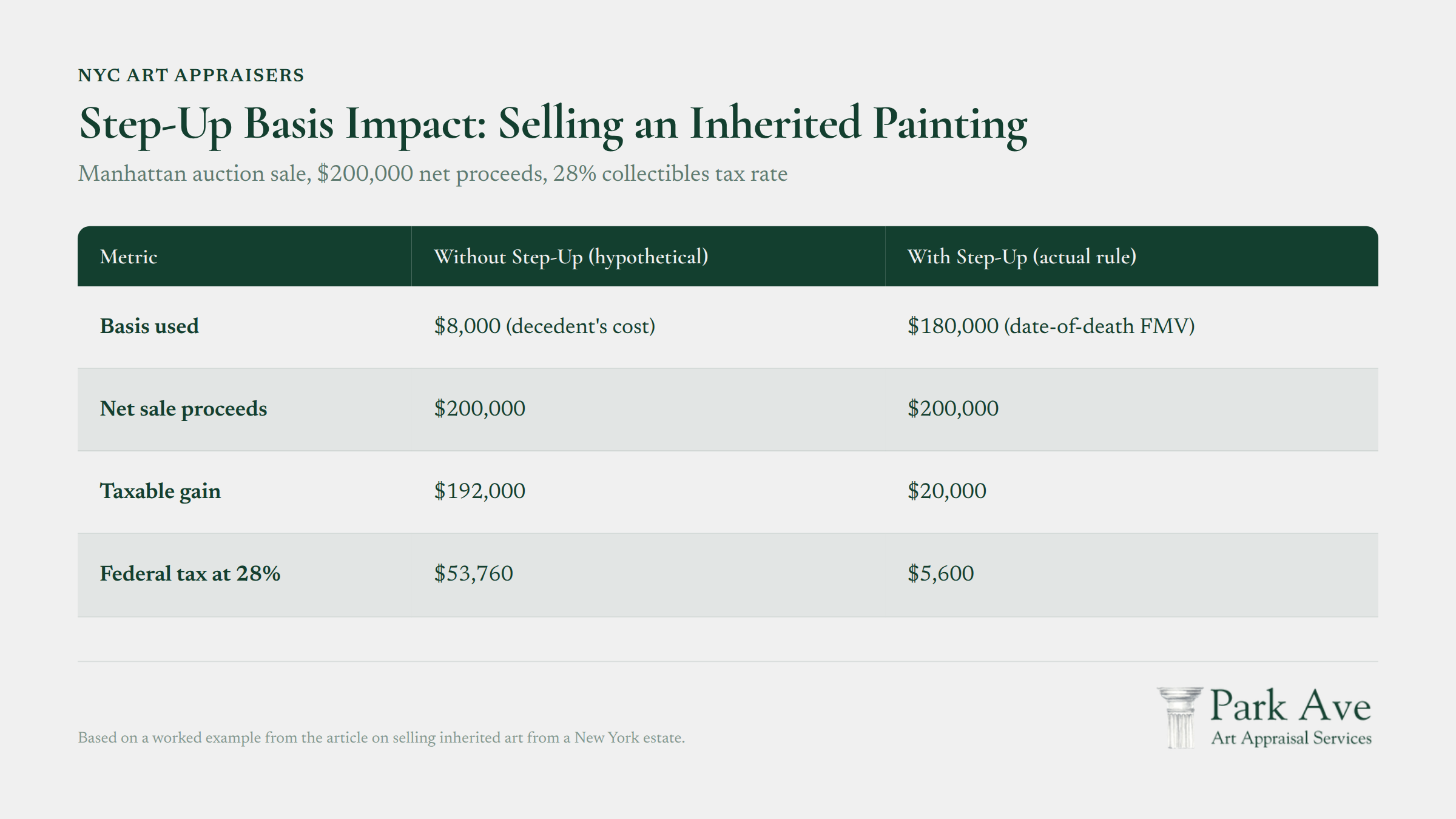
Here's how the numbers actually move. Suppose a decedent bought a painting decades ago for $8,000. At death, a qualified appraisal establishes a fair market value of $180,000. Two years later, the heir consigns the piece to a Manhattan auction house and nets $200,000 after the seller's commission and other selling costs.
| Without step-up (hypothetical) | With step-up (actual rule) | |
|---|---|---|
| Basis used | $8,000 (decedent's cost) | $180,000 (date-of-death FMV) |
| Net sale proceeds | $200,000 | $200,000 |
| Taxable gain | $192,000 | $20,000 |
| Federal tax at 28% collectibles rate | $53,760 | $5,600 |
The step-up doesn't erase tax on the sale, the heir still owes capital gains tax on the $20,000 of appreciation that happened after death. What it eliminates is tax on the decades of appreciation that happened before death, which in this example is the difference between a $5,600 bill and a $53,760 one. That gap is exactly why the date-of-death appraisal matters: it's the only thing standing between the heir and having to argue, after the fact, what the painting was worth years earlier.
The 28% Collectibles Rate and the Net Investment Income Tax
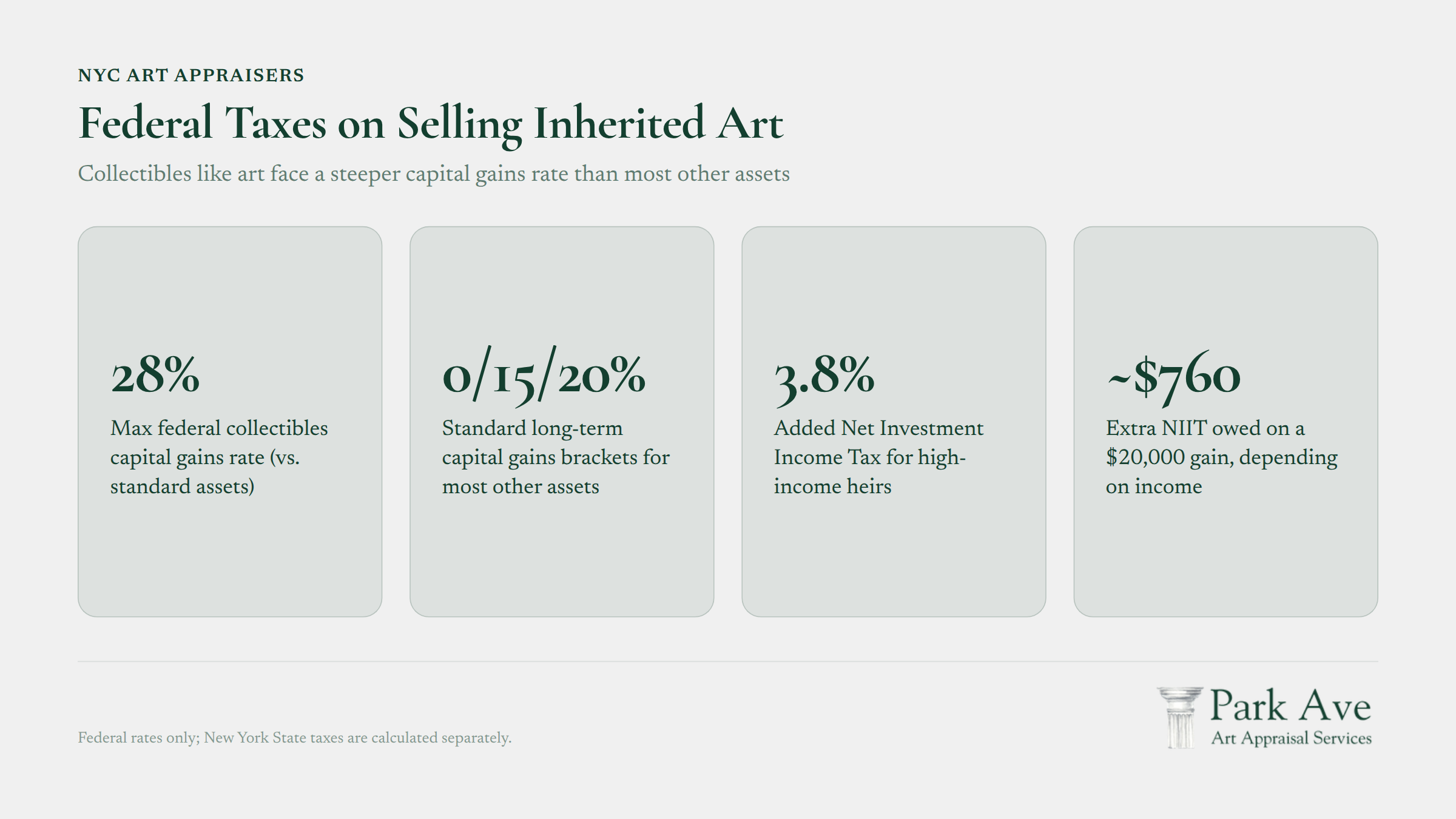
Art is treated as a collectible for federal tax purposes, and long-term gains from collectibles are taxed at a maximum federal rate of 28%, higher than the 0%, 15%, or 20% brackets that apply to most other long-term capital assets. Because property acquired from a decedent is automatically treated as held long-term, this 28% ceiling, not a short-term ordinary-income rate, is what applies even if the heir sells within months of inheriting.
High-income heirs may owe an additional 3.8% Net Investment Income Tax on top of the collectibles rate, once modified adjusted gross income crosses the applicable threshold. For a $20,000 gain like the one above, that could add up to roughly $760 more, depending on the taxpayer's overall income picture. These are federal taxes, calculated independently of anything owed to New York State.
New York State Tax Treatment of the Sale
New York does not impose a separate inheritance tax simply because an heir received artwork. What New York does tax, for a resident heir, is the capital gain itself, folded into the state's personal income tax return starting from the taxpayer's federal adjusted gross income. New York's estate tax (the one that applies to the estate itself, at death) is a separate system entirely from the income tax owed later when the heir sells the piece; the New York State Department of Taxation and Finance's estate tax guidance addresses the estate-level rules, not the later sale.
Nonresident heirs face a more fact-specific analysis. If the art was located, held, or sold in New York, questions about New York-source income can arise, and the right answer depends on the specifics of the estate and the sale. This is a good spot to loop in a CPA familiar with New York sourcing rules before assuming either state has no claim on the gain.
Consigning at Sotheby's, Christie's, or a Gallery: What Changes and What Doesn't
The tax math is the same whether the piece sells through a major auction house, a private gallery, or a direct sale. What changes is the selling-cost deduction. Auction house commissions, buyer's premium splits that affect net proceeds, shipping, insurance, and authentication fees charged by the house all reduce the amount realized before the gain is calculated. A hammer price is not the same as net proceeds, and the final settlement statement from the house is the document that establishes what was actually realized.
Heirs and executors should keep the full documentation trail together: the date-of-death appraisal, the estate tax return and schedules if one was filed, any IRS Form 8971 and beneficiary schedule the estate issued, probate or distribution records, and the auction house's final settlement statement. If the estate went through probate in Manhattan, the process for establishing that original value is covered in our guide to art appraisal in New York probate.
Protect the Step-Up Before You Consign
The stepped-up basis is one of the more favorable rules in the tax code for anyone inheriting art, but it only works in the heir's favor if the date-of-death value is documented well enough to survive scrutiny. A vague estimate, an old insurance appraisal, or a guess based on what a similar piece sold for years ago won't hold up the way a dated, market-specific appraisal will.
Before consigning an inherited piece to a Manhattan auction house or gallery, get the valuation question settled first, ideally with the same appraisal that supported the estate's tax filing. Our team prepares USPAP-compliant, IRS-qualified appraisals for exactly this purpose, and can scope a fixed fee once we know the piece, its provenance, and what the sale timeline looks like.
This article is provided for general informational purposes only and does not constitute legal, tax, or financial advice. Readers should consult a qualified attorney or CPA regarding their specific circumstances.