
Blog
Art Insurance Appraisal in New York: How Much Coverage Needs a Rider
A standard New York homeowners or co-op policy caps fine art coverage far below what most collections are worth, and there is no single statewide dollar threshold that forces a written appraisal. This guide explains when a scheduled rider makes sense, what insurers actually want to see, and why replacement value, not fair market value, drives the number on your policy.
If you own original artwork and live under a New York homeowners, renters, or co-op (HO-3, HO-4, or HO-6) policy, there is a good chance your collection is underinsured and you do not know it. These base policies were built for furniture and electronics, not for a painting that has tripled in value since you bought it. Here is what actually triggers the need for a scheduled fine art rider in New York, what insurers expect to see before they issue one, and why the appraisal you get for insurance purposes looks different from one you would get for a sale or a donation.
Why a Standard New York Homeowners Policy Under-Covers Art
A standard HO-3, HO-4, or HO-6 policy treats fine art as ordinary personal property, which means it falls under a special-limits sublimit buried in the policy's fine print rather than being covered at its full value. Those sublimits exist for categories like jewelry, furs, silverware, and fine art precisely because insurers do not want to pay full replacement cost on a high-value item that was never individually documented.
The New York Department of Financial Services advises consumers to schedule valuable property such as fine art, antiques, and collectibles separately, using a personal articles floater, rather than relying on the base policy's blanket personal property coverage, because the blanket limit was never designed to absorb a single high-value asset (NY DFS). In practice, this means a painting worth $30,000 sitting on your living room wall in a Manhattan co-op might be covered for a few thousand dollars at most if a fire or burst pipe destroys it, unless you have scheduled it.
This is also where our fine art appraisal services come into the picture before a loss ever happens. An appraisal report is the document that lets your broker schedule the piece at its real value in the first place, and it is the same report your insurer will ask for again if you ever need to file a claim.
What Triggers the Need for a Scheduled Fine Art Rider
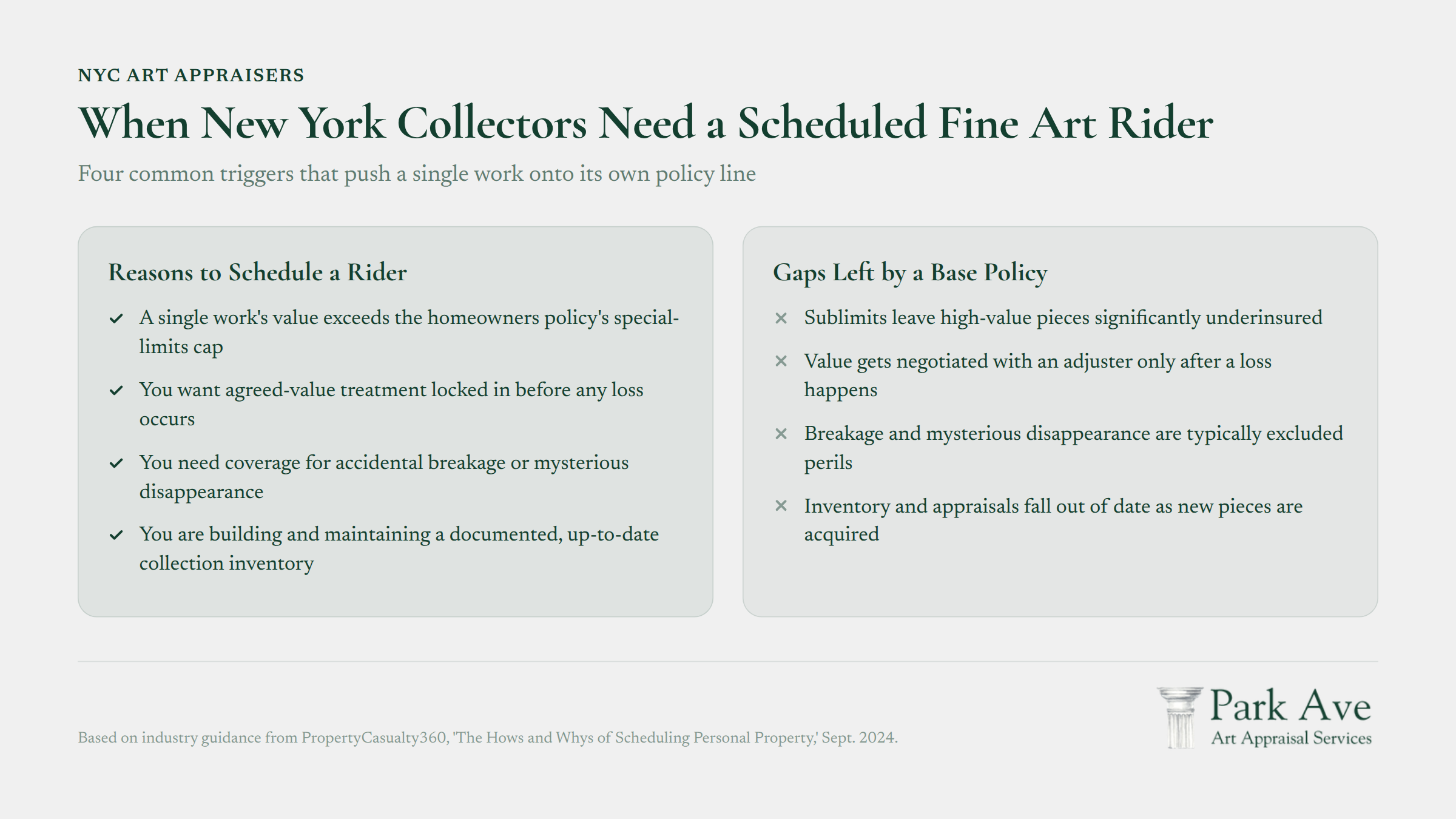
A scheduled rider becomes necessary the moment a single work's value exceeds what the base policy's special limit will pay, but value alone is not the only reason collectors schedule art. Four situations come up most often among New York collectors:
- A single work exceeds the policy's special-limits cap. Once one painting or sculpture is worth more than the sublimit buried in your homeowners policy, that piece needs its own line item.
- You want agreed-value treatment. A scheduled floater can lock in an agreed amount up front, so you are not negotiating value with an adjuster after a loss has already occurred.
- You need coverage for accidental breakage or mysterious disappearance. Base policies typically exclude these perils for art and collectibles; a fine art rider usually adds them back in.
- You are building a documented collection inventory. Collectors who acquire steadily, through galleries, auction houses, or inheritance, often schedule pieces as they are added so the inventory and the appraisal stay current together.
Industry guidance on scheduling personal property generally frames the decision the same way: once an item's value crosses the point where the base policy's limit would leave a meaningful gap, scheduling it individually is the more defensible choice (PropertyCasualty360).
Is There a Dollar Threshold That Requires an Art Insurance Appraisal in New York?
No. New York does not set a statewide dollar amount that triggers an appraisal requirement for a fine art rider. The threshold, if one exists at all, is set by the individual insurer underwriting the policy, not by state law.
New York Insurance Law's appraisal clause provisions address what happens after a loss, when the insured and the carrier disagree on the value of a claim and either side invokes the right to appraisal; that is a dispute-resolution mechanism, not a pre-loss documentation rule (NY DFS). Carrier practices vary widely. Some fine art insurers commonly expect a professional appraisal once an individual work is valued above roughly $5,000 to $10,000, while at least one major carrier is reported to require a formal appraisal only once a work reaches $500,000 or more, accepting a detailed description and estimated value below that line (Masterworks).
What is consistent, though, is the practical trigger point. Once a piece exceeds a low sublimit, commonly somewhere in the $1,500 to $2,500 range for valuable property categories on a standard policy, a scheduled floater is simply the more sensible path regardless of exactly which number your carrier uses for appraisal paperwork (Vantage Point Risk). Below that line, a receipt might satisfy the underwriter. Above it, expect the conversation to shift toward a written appraisal.
Key takeaway: Do not wait for a number to tell you an appraisal is required. If a work is appreciating, inherited, or lacks a clean paper trail, get it appraised before you try to schedule it, not after the underwriter asks.
Replacement Value vs Fair Market Value: Why Insurers Want the Higher Number
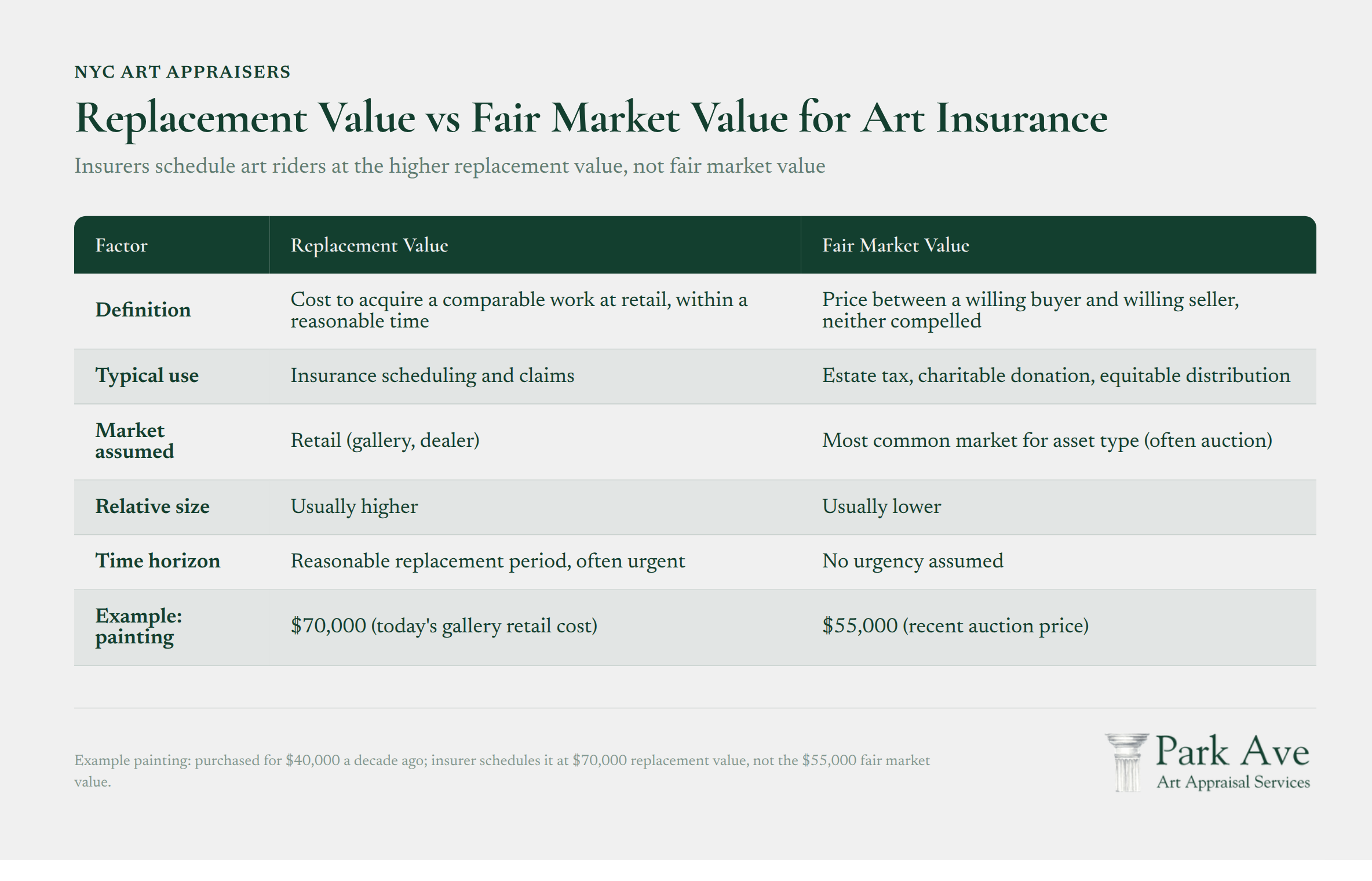
Insurers price a fine art rider using replacement value, not fair market value, and the two can differ substantially. Replacement value is the cost to acquire a comparable work, of similar quality, medium, and reputation, at retail, within a reasonable period of time. Fair market value is the price a willing buyer would pay a willing seller, neither under compulsion, in the most common marketplace for that type of property, such as a relevant auction or dealer market.
Replacement value is almost always the higher figure because it assumes you have to go out and buy a substitute quickly, at retail, rather than wait for the right auction lot to come along at a negotiated price. This distinction is foundational to how professional appraisers are trained to approach insurance work, and it matters because an underinsured policy based on fair market value can leave a real gap if a work is ever destroyed.
| Factor | Replacement Value | Fair Market Value |
|---|---|---|
| Definition | Cost to acquire a comparable work at retail within a reasonable time | Price between a willing buyer and willing seller, neither compelled |
| Typical use | Insurance scheduling and claims | Estate tax, charitable donation, equitable distribution |
| Market assumed | Retail (gallery, dealer) | Most common market for the asset type (often auction) |
| Relative size | Usually higher | Usually lower |
| Time horizon | Reasonable replacement period, often urgent | No urgency assumed |
Example: A painting purchased from a gallery for $40,000 ten years ago might carry a fair market value of $55,000 at a relevant auction house today, but a replacement value of $70,000 if the artist's retail gallery prices have climbed faster than the secondary market. An insurer schedules the piece at $70,000, not $55,000, because that is what it would actually cost you to replace it on short notice.
What Documentation Do Insurers Want: Appraisal or Receipt?
A recent purchase invoice is often enough to schedule a work when the price is current and the seller is established, but insurers increasingly want a full written appraisal once the paper trail gets thinner. The deciding factors are usually how the work was acquired, how long ago, and whether the artist is still actively selling at retail.
| Acquisition Scenario | What Insurers Typically Want |
|---|---|
| Recent gallery or primary-market purchase, invoice in hand | Purchase receipt may be sufficient, especially for lower values |
| Work has appreciated materially since purchase | Updated written appraisal reflecting current replacement value |
| Inherited piece, no purchase record | Written appraisal required; no receipt exists to anchor value |
| Secondary-market or deceased artist's work | Written appraisal, since retail comparables are harder to establish |
| No recent invoice or documentation lost | Written appraisal to re-establish a defensible value |
Watch out: A ten-year-old receipt is not a substitute for a current appraisal if the artist's market has moved. Insurers know retail prices shift, and an outdated invoice can leave you underinsured without you realizing it until a claim is already underway.
A written appraisal intended for insurance purposes should document that the piece exists as described and establish its value as of the inspection date, since the report may later be read by an underwriter, and in the event of a loss, by a claims adjuster or the courts. That means the report needs full support: artist or maker, title, medium, dimensions, condition, provenance, photographs, and the basis of value used to reach the number.
NYC Co-op and High-Rise Realities
Living with a serious art collection in a New York high-rise introduces a few practical wrinkles that collectors outside the city rarely deal with.
- Board-mandated certificates of insurance. Many co-op and condo boards require proof of a homeowner's or renter's policy before a resident can move in, and some ask for updated certificates annually; a scheduled fine art rider typically needs to be reflected on that certificate.
- Elevator and moving risk. Art moving in and out of a high-rise, whether for a renovation, a gallery loan, or a move between apartments, is exposed to handling risk that a stationary piece on the wall is not. Confirm whether your rider covers transit, or whether you need a separate in-transit endorsement for art fairs or offsite storage.
- Climate-controlled apartment storage versus art in transit. A painting hanging in a climate-controlled Manhattan apartment faces different risks than the same piece crated for an art fair or a storage facility; some policies price these exposures differently, so confirm what your floater actually covers in each scenario.
- Periodic reappraisal. New York's gallery and auction markets move quickly, and an appraisal that was accurate three years ago may no longer reflect current replacement cost. A reappraisal every 3 to 5 years is a reasonable baseline, and sooner for artists whose secondary market has been especially volatile.
Getting a Defensible Appraisal Before You Schedule a Work
Our appraisers hold credentials with organizations such as the American Society of Appraisers (ASA), the International Society of Appraisers (ISA), and the Appraisers Association of America (AAA), and every insurance appraisal we prepare follows the Uniform Standards of Professional Appraisal Practice (USPAP) set by The Appraisal Foundation. If you want more detail on what makes a report defensible to an underwriter or a court, our guide on USPAP-compliant fine art appraisal walks through the specific requirements.
For artwork, our published fees for a standard appraisal start at $295, with typical engagements for insurance scheduling running between $595 and $2,000 depending on the number of works, the depth of research required, and the completeness of existing records. Every engagement is quoted as a fixed fee after we scope the assignment, never billed by the hour.
If you are ready to schedule a piece, update an aging appraisal, or simply find out whether your collection is adequately covered, you can request an art appraisal and our team will scope the engagement before any work begins.
This article is provided for general informational purposes only and does not constitute legal, tax, or financial advice. Readers should consult a qualified attorney, insurance broker, or CPA regarding their specific circumstances.