
Blog
Using a Fine Art Collection as Loan Collateral in New York: What Collectors Need to Know
Pledging a fine art collection as loan collateral in New York works through the UCC lien system, letting collectors borrow against their art without giving up possession. This guide explains how lenders size these loans, which appraisal value premise applies, and what a lender-ready appraisal must include.
New York collectors increasingly borrow against their art instead of selling it, using paintings, sculpture, and other fine art as collateral while the work stays on the wall. The mechanics run through New York's enactment of Article 9 of the Uniform Commercial Code, and the amount a lender will extend almost always traces back to a professional appraisal. This guide covers how art-backed lending works in New York, how lenders and appraisers think about value, and what a lender-ready appraisal needs to contain. Our fine art appraisal team prepares reports for exactly this purpose, alongside more familiar uses like donating a work to a museum, because a collateral appraisal is built differently from either of those.
Why New York Concentrates Art-Backed Lending
New York's private banking arms, including desks at JPMorgan, Citi, Bank of America, and Goldman Sachs, have built dedicated art lending practices, and the city is also home to specialty lenders such as Athena Art Finance and Emigrant Bank Fine Art Finance. None of these firms partner with any single appraisal provider; they're simply the landscape a collector encounters when shopping for an art-backed loan in New York.
That concentration isn't a coincidence. The global art-secured lending market is estimated to reach between $29 billion and $34.1 billion by the end of 2023, growing roughly 11% year over year, according to Deloitte and ArtTactic's Art Finance research. New York captures an outsized share of that volume because it pairs lender density with the auction infrastructure of Sotheby's, Christie's, and Phillips, all of which run major New York operations and generate the sale records that both appraisers and lenders rely on when they price a work.
How New York's UCC Lien System Lets You Keep Your Art
A collector can borrow against a painting without shipping it to a bank vault because New York's Article 9 lien system allows a security interest to attach without transferring possession. Fine art pledged as collateral is classified as "goods" under the UCC, and a lender's security interest in it can be perfected either by filing a UCC-1 financing statement with the New York Department of State or by taking physical possession of the work, per Cornell Law School's overview of secured transactions law.
For a collector loan, filing is the more common route, since it lets the borrower keep the artwork on display while the loan is outstanding. Possession-based perfection, moving the work into a climate-controlled art warehouse under a tri-party agreement among the collector, lender, and warehouse, tends to show up in larger or higher-risk collector loans and is standard for gallery inventory loans, per Greenberg Traurig's analysis of art lending structures. Priority between competing creditors generally goes to whichever party perfects first, so a lender's UCC-1 filing or possession establishes its claim ahead of later creditors, per Lexology's review of New York art lending law.
Watch out: If a pledged work is sold while a loan is outstanding, the lender's security interest generally follows the sale proceeds, but a perfected interest in those proceeds can lapse after 21 days unless specific conditions are met under New York's UCC proceeds rule. Collectors planning to sell a pledged work should coordinate with the lender before the sale, not after.
Fair Market Value or Liquidation Value: Which Premise Does Your Lender Need?
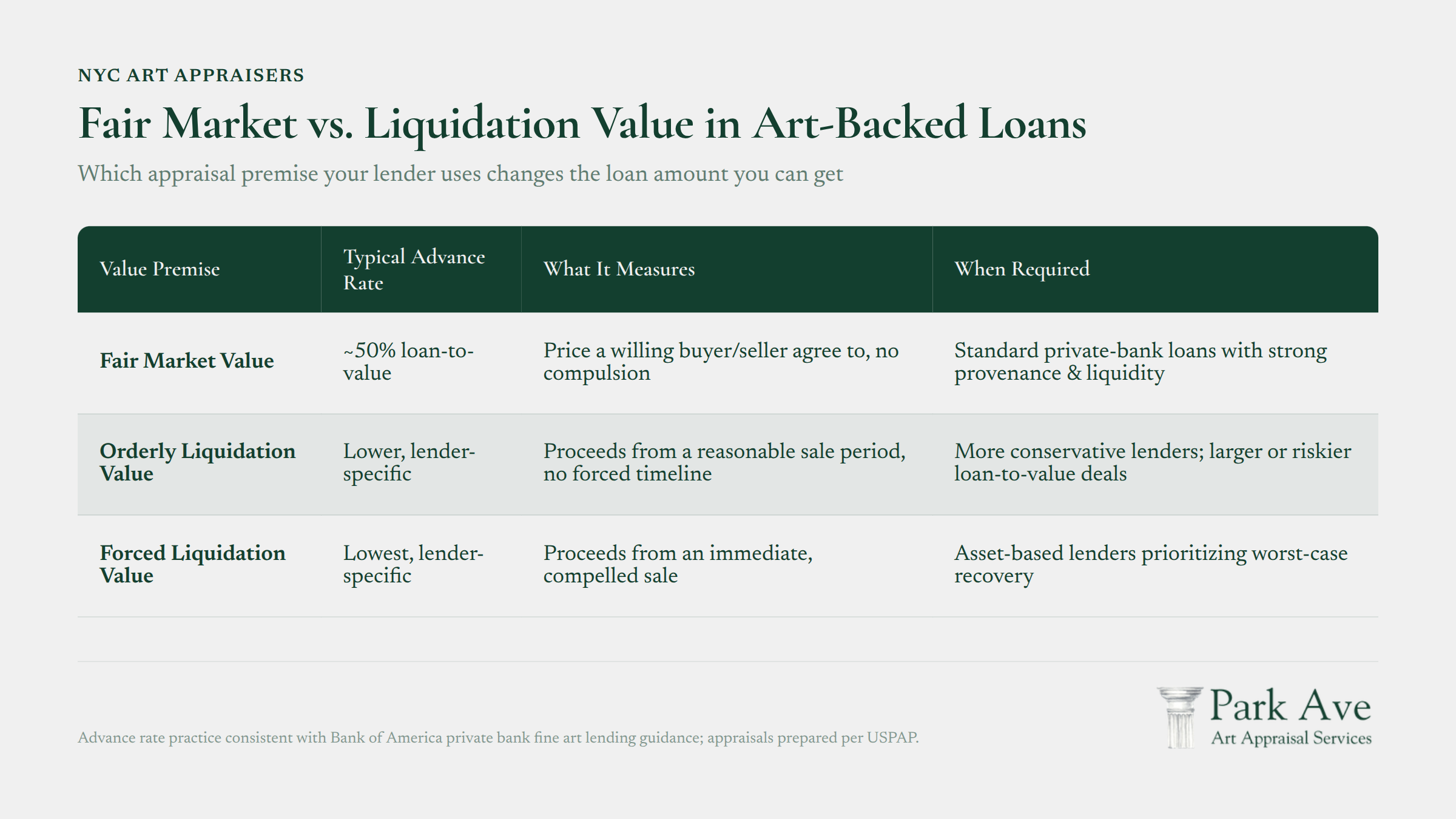
The direct answer: it depends on how the lender manages risk, and the appraisal has to say so plainly. Many private banks size an art-backed loan against fair market value, commonly advancing around 50% of that value as the loan amount, a ratio consistent with published fine art lending guidance from Bank of America's private bank. Other lenders, following general asset-based lending practice, instead ask the appraiser to conclude a liquidation value, either orderly or forced, which is a more conservative estimate of what the lender could actually recover if it had to sell the collateral quickly in a default.
These two premises are not interchangeable, and a report that blends them is not useful to anyone. USPAP requires the appraiser to state the applicable value definition and the intended use of the report clearly, so the lender, the collector, and any reviewing party are all working from the same number for the same reason. Our appraisers hold credentials with organizations such as the ASA and ISA and prepare every collateral report in accordance with USPAP, stating the value premise up front rather than leaving it to interpretation.
| Value Premise | Typical Advance Rate | What It Measures | When a Lender Requires It |
|---|---|---|---|
| Fair market value | Around 50% loan-to-value | Price a willing buyer and willing seller would agree to, with neither under compulsion | Standard private-bank collector loans with strong provenance and liquidity |
| Orderly liquidation value | Lower advance rate, lender-specific | Proceeds achievable in a reasonable sale period without a forced timeline | More conservative lenders, larger or riskier loan-to-value structures |
| Forced liquidation value | Lowest advance rate, lender-specific | Proceeds achievable in an immediate, compelled sale | Asset-based lenders prioritizing worst-case recovery over collection value |
What a Lender-Ready Fine Art Appraisal Must Include
A report built for a bank's collateral file looks different from one built for insurance or a tax filing, and lenders in New York generally expect the following:
- A current professional appraisal. Most private banks in this space require reappraisal on an annual basis for as long as the loan remains outstanding, since collateral value can shift with the market.
- A written scope of work. The report needs to state, in plain language, which value premise governs (fair market, orderly liquidation, or forced liquidation) and the specific intended use as loan collateral.
- Provenance and condition documentation. Ownership history and a condition assessment support both the value conclusion and the lender's ability to monitor the collateral over the loan term.
- A clearly stated intended use. The report must identify the loan itself as the reason the appraisal exists, distinct from insurance coverage or an estate or donation filing.
- A defined engagement fee. Our team quotes collateral appraisals as a fixed fee after scoping the collection, never billed hourly.
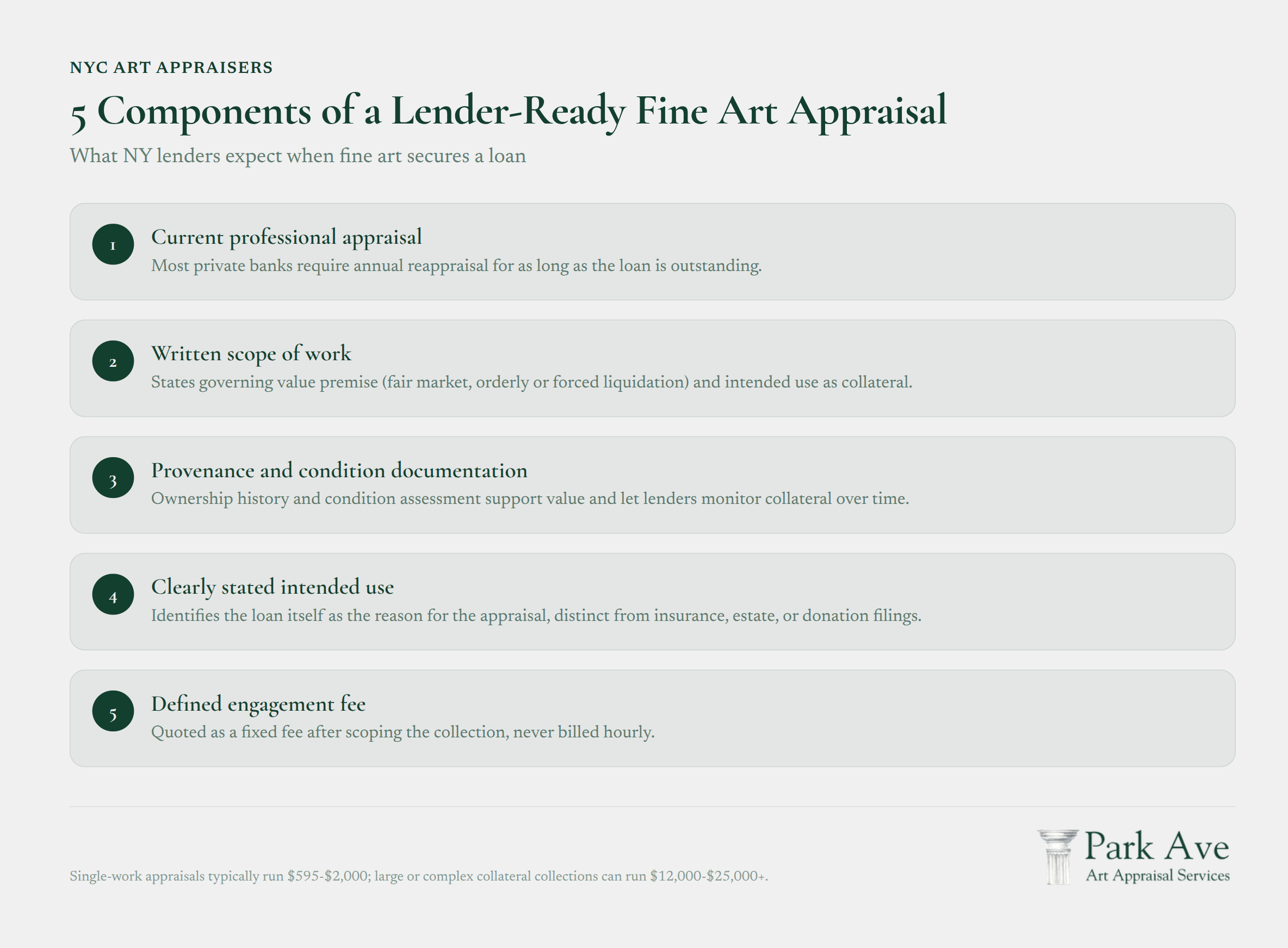
For a single work, our artwork appraisal fees typically run $595 to $2,000 for an IRS-qualified or standard report, while a large or highly complex collection intended for a lending relationship can run $12,000 to $25,000 or more. That range is driven by the size of the collection, the completeness of existing provenance records, and the depth of research the value premise demands, not by the dollar value the works end up carrying.
How a Collateral Appraisal Differs from a Donation or Insurance Appraisal
A collateral appraisal, a donation appraisal, and an insurance appraisal can all describe the same painting and still reach different conclusions, because each one answers a different question. A donation appraisal supports a charitable deduction and follows IRS rules on qualified appraisals and fair market value. An insurance appraisal typically supports a replacement cost figure so a policy can be written or a claim can be settled. A collateral appraisal exists solely to tell a lender what it could recover, under a value premise the lender itself chooses.
Mixing these up creates real problems. A report written for insurance purposes, with a replacement cost conclusion, will not satisfy a bank's collateral file, and a lender will typically reject it outright rather than ask for a revision. Collectors who plan to use the same collection for more than one purpose (a loan now, a donation later) generally need separate reports, each scoped to its own intended use.
Put Your Collection to Work Without Losing It
Borrowing against a fine art collection in New York gives collectors liquidity without forcing a sale, but the loan only works as well as the appraisal behind it. A report with the wrong value premise, a missing scope of work, or a stale valuation date can slow down a closing or shrink the amount a lender is willing to advance. If you're structuring an art-backed loan in New York, our team can prepare the current, USPAP-compliant appraisal your lender needs, scoped specifically for collateral use. Request an appraisal to get started.
This article is provided for general informational purposes only and does not constitute legal, tax, or financial advice. Readers should consult a qualified attorney or CPA regarding their specific circumstances.